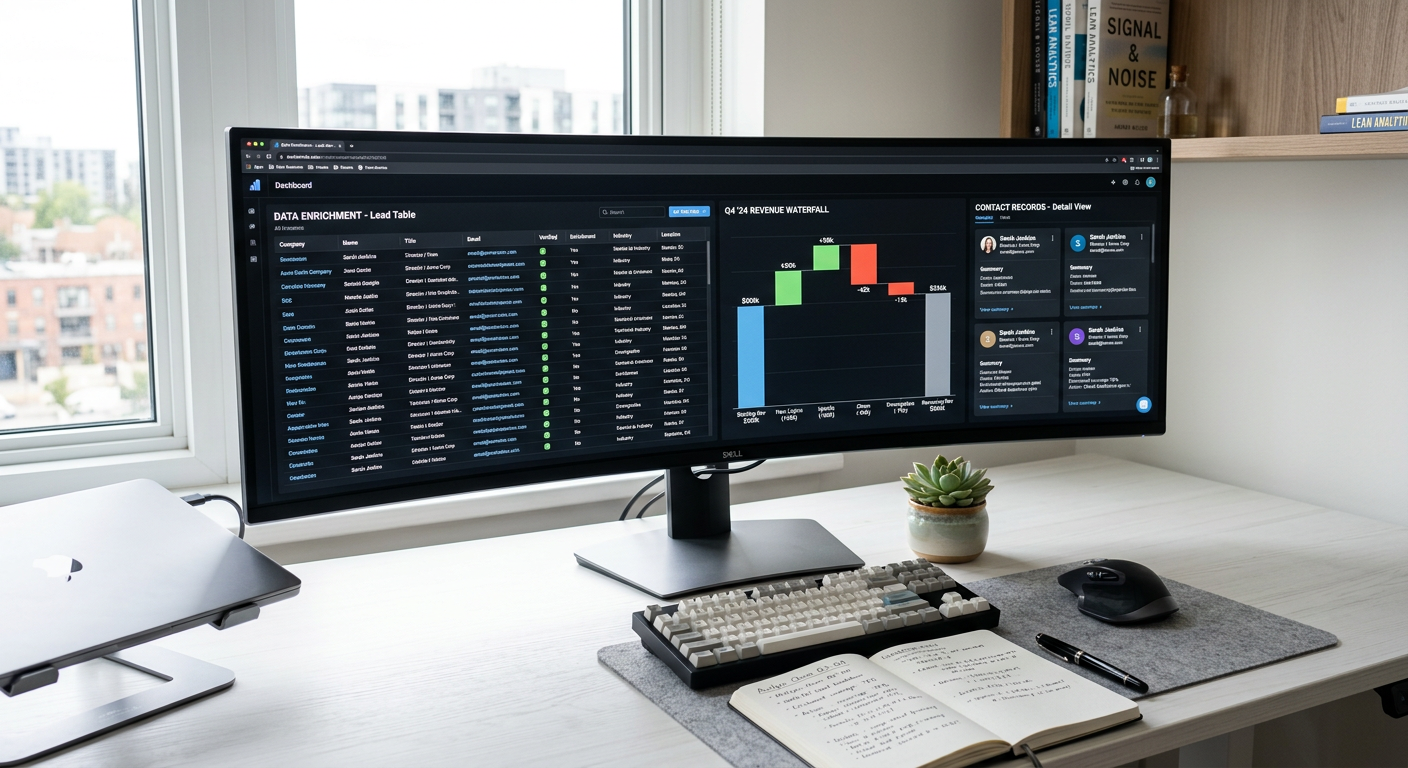
ACA and Clay are both GTM tools - but they solve fundamentally different problems. Clay is a data enrichment and orchestration platform that helps you find, enrich, and score leads using 150+ data providers. ACA is a multi-channel outreach and content generation platform that helps you reach those leads across 6 channels and generate on-brand content. Many teams actually use both. This comparison uses verified pricing and feature data pulled directly from Clay's website on April 2, 2026.
TL;DR - Quick Comparison
| Dimension | Clay | ACA |
|---|---|---|
| Primary focus | Data enrichment and GTM orchestration | Multi-channel outreach + AI content generation |
| Best for | Finding and enriching leads at scale | Reaching leads across 6 channels + creating content |
| Outreach channels | Email only (basic native sequencer) | LinkedIn, Email, WhatsApp, Instagram, Telegram, SMS |
| Starting price | Free, then /mo (annual) | BYOK model, $50-80/mo |
| Data enrichment | 150+ providers, waterfall logic | Basic contact enrichment |
| Content generation | No | Full AI content pipeline |
| White-label | No | Yes, included |
| Verdict | Pick Clay for data enrichment and lead research | Pick ACA for multi-channel outreach and content |
What Is Clay?
Clay is an AI-powered data enrichment and GTM orchestration platform used by over 300,000 GTM teams. It is not primarily an outreach tool. Instead, Clay sits at the top of your sales pipeline: it helps you build targeted lead lists, enrich those leads with data from 150+ providers, score and qualify them, and then push enriched data to your outreach tools and CRM.
What makes Clay stand out is its waterfall enrichment logic. Instead of relying on a single data vendor (and accepting whatever coverage gaps that vendor has), Clay queries multiple providers in sequence for each data point. If Provider A does not have a prospect's email, it tries Provider B, then C, and so on. This dramatically improves coverage compared to using any single enrichment tool.
Clay also has AI-powered research agents. Claygent can browse the web, read company pages, and extract custom data points - things like "what tech stack does this company use" or "when did they last raise funding." Sculptor is their AI chat interface for generating GTM ideas and building enrichment tables through natural language.
Clay does have a native email sequencer (Clay Sequencer), but email sending is not its core strength. Most Clay users push their enriched data to dedicated outreach tools for actual campaign execution. The platform has reached $100M ARR and counts companies like OpenAI, Anthropic, and Vanta as customers.
What Is ACA?
ACA (Automated Client Acquisition) is an AI-powered platform that combines multi-channel outreach and content generation in one system. It supports 6 outreach channels natively - LinkedIn, Email, WhatsApp, Instagram, Telegram, and SMS - all managed through a visual drag-and-drop sequence builder and unified inbox.
Where Clay focuses on the "who should I reach out to and what do I know about them" problem, ACA focuses on the "how do I actually reach them and what do I say" problem. ACA includes a full AI content generation pipeline (posts, carousels, newsletters, videos), a CRM with ICP scoring, lead magnet campaigns, and white-label capabilities for agencies.
ACA uses a BYOK (Bring Your Own Key) pricing model where you connect your own AI API keys and pay actual usage costs instead of inflated SaaS pricing. Platform cost runs $50-80/mo and includes all channels, content generation, CRM, inbox, white-label, and lead import via Apify integration.
Feature-by-Feature Comparison
| Feature | Clay | ACA |
|---|---|---|
| Data enrichment providers | 150+ with waterfall logic | Basic contact enrichment |
| AI research agents | Claygent + Sculptor | No |
| Intent signals | Job changes, web intent, social listening | No |
| Email outreach | Basic native sequencer | Yes - via connected email accounts |
| LinkedIn outreach | No | Yes - connection requests, messages, InMail |
| WhatsApp outreach | No | Yes - native channel |
| Instagram DMs | No | Yes - native channel |
| Telegram | No | Yes - native channel |
| SMS | No | Yes - native channel |
| Visual sequence builder | No | Yes - drag-and-drop with branching logic |
| AI content generation | No | Posts, carousels, newsletters, videos, articles |
| Unified inbox | No | All 6 channels in one inbox |
| CRM | Integrations only (Salesforce, HubSpot - Growth+) | Built-in with pipeline + ICP scoring |
| White-label | No | Yes - full branding, isolated workspaces |
| MCP integration | Yes (Claygent MCP connections) | Native Model Context Protocol support |
| CRM auto-enrichment | Yes (Growth+) | No |
| Ad audience push | LinkedIn Ads, Meta Ads (Growth+) | No |
| Data warehouse sync | Snowflake, BigQuery, Databricks (Enterprise) | No |
| BYOK (own API keys) | Yes (skips Data Credits, uses Actions only) | Yes (core pricing model) |
Pricing Comparison
Clay and ACA have very different pricing models. Clay uses a usage-based system with two separate cost dimensions (Actions and Data Credits). ACA uses a flat BYOK model.
Clay Pricing
Clay measures usage in two currencies: Actions (platform operations like enrichment runs, AI calls, and integrations) and Data Credits (purchased data from Clay's 150+ providers). Both are consumed as you use the platform.
| Plan | Annual (per mo) | Key Limits |
|---|---|---|
| Free | Free | 500 actions/mo, 100 data credits/mo, 200 rows/table |
| Launch | From $167/mo | 15,000 actions/mo, 2,500 data credits/mo, 50K rows/table |
| Growth | From $446/mo | 40,000 actions/mo, 6,000 data credits/mo, 50K rows/table |
| Enterprise | Custom | 200,000+ actions/mo, 100,000+ data credits/mo, unlimited rows |
A few important details about Clay pricing:
- Data Credits start at $0.05 each and get cheaper at scale. Actions start at less than $0.01 each.
- BYOK option - you can bring your own API keys for data providers, which skips Data Credit costs but still uses Actions.
- Credit top-ups cost 30% more on Launch and Growth plans. If you run out mid-month, refilling is expensive.
- CRM integrations require Growth ($446+/mo). If you need to sync with Salesforce or HubSpot, the Launch plan will not work.
- Unused credits roll over up to 2x your monthly amount on Launch and Growth plans.
ACA Pricing
ACA uses a BYOK (Bring Your Own Key) model. You connect your own AI API keys (OpenAI, Anthropic, etc.) and pay actual usage costs. Platform cost runs $50-80/mo and includes all 6 outreach channels, content generation, CRM, unified inbox, white-label, and lead import via Apify integration.
Key difference: Clay's pricing is usage-based and can be unpredictable. Actions and Data Credits are separate cost dimensions, and heavy enrichment workflows can consume credits quickly. ACA's pricing is predictable - you pay a flat platform fee plus your actual AI API costs.
What Clay Does Better
Being very honest about this - Clay is best-in-class at data enrichment, and it is not particularly close:
- 150+ data enrichment providers - Clay aggregates more data sources than any other GTM platform. The waterfall logic means you get better coverage than any single provider can offer. This is their core product and they do it exceptionally well.
- AI research agents - Claygent can browse the web and extract custom data points that no structured database would have. "What CRM does this company use?" or "Did they recently hire a VP of Sales?" - Claygent can answer these by actually reading company pages. ACA has nothing comparable.
- Intent signals - Job changes, web intent tracking, company news, and social listening signals. These help you time your outreach based on trigger events. ACA does not track intent signals.
- CRM enrichment workflows - Clay can continuously enrich and maintain your CRM data, keeping contact records fresh. This is valuable for teams with large existing databases.
- Enterprise security - SOC 2 Type II, ISO 27001, ISO 42001, GDPR, CCPA. Clay has enterprise-grade compliance certifications that matter for large organizations.
- Scale and ecosystem - 300,000+ GTM teams, $100M ARR, backed by major tech companies. Clay has a massive user base and a proven track record at scale. Companies like OpenAI, Anthropic, and Vanta use it.
- Ad audience building - Push enriched audiences directly to LinkedIn Ads and Meta Ads. Useful for account-based marketing plays.
What ACA Does Better
- 6 native outreach channels - LinkedIn, Email, WhatsApp, Instagram, Telegram, SMS - all in one sequence builder with branching logic. Clay has a basic email sequencer and pushes to external tools for everything else.
- AI content generation - Full content pipeline for posts, carousels, newsletters, videos, and articles using brand voices, characters, and ICPs. Clay is a data platform, not a content platform.
- Visual campaign builder - Drag-and-drop sequence builder with conditional nodes, channel switching, and multi-path campaigns. Clay does not have campaign orchestration.
- White-label for agencies - Full branding with isolated client workspaces, included in the platform. Clay does not offer white-labeling.
- Unified inbox - One inbox for all 6 channels. Reply to LinkedIn messages, emails, WhatsApp messages, and Instagram DMs from the same screen. Clay has no inbox.
- Built-in CRM with ICP scoring - ACA includes a CRM with pipeline management and ICP scoring. Clay integrates with external CRMs but does not include its own (and CRM integrations require the Growth plan at $446+/mo).
- Predictable pricing - ACA's flat BYOK model is simple to budget. Clay's dual-currency system (Actions + Data Credits) can be harder to predict, especially for teams doing heavy enrichment.
Who Should Choose Clay
Clay is the right choice if:
- Your biggest problem is data quality and coverage - you need verified emails, phone numbers, company data, and technographics from multiple sources
- You need AI research agents that can browse the web and extract custom data points for highly targeted outreach
- You want to enrich and maintain your existing CRM data with automated workflows
- You run account-based marketing and need intent signals, job change triggers, and enriched account data
- You already have outreach tools (like Instantly, SmartLead, or ACA) and need a data layer to feed them better leads
- You work at an enterprise organization that requires SOC 2, ISO 27001, and formal compliance certifications
Who Should Choose ACA (or Use Both)
ACA is the right choice if:
- You need to actually reach prospects across LinkedIn, email, WhatsApp, Instagram, Telegram, or SMS - not just enrich their data
- You need AI content generation for your business or clients - posts, carousels, newsletters, videos
- You are an agency that needs white-labeling with isolated client workspaces
- You want one platform that handles outreach, content, CRM, and inbox instead of stitching together separate tools
- You want predictable BYOK pricing where costs scale with actual usage
The "Use Both" Play
Because Clay and ACA solve different problems, some teams use both. The workflow looks like this:
- Clay finds and enriches leads - waterfall enrichment, AI research, intent signals, lead scoring
- Export enriched leads from Clay as CSV or push via webhook
- ACA runs multi-channel outreach campaigns against those enriched leads - LinkedIn sequences, email follow-ups, WhatsApp messages, content distribution
This gives you Clay's best-in-class data enrichment feeding into ACA's multi-channel execution. If you are running complex B2B campaigns where data quality directly impacts response rates, this combination makes sense. You can also connect the two platforms through n8n automations for a fully automated pipeline.
That said, not every team needs this level of sophistication. If your lead data comes from a simpler source (LinkedIn Sales Navigator exports, Apify scraping, manual lists), ACA on its own handles the enrichment, outreach, and content generation in one platform.
Frequently Asked Questions
Can I use Clay and ACA together?
Yes, and this is actually a strong combination. Clay handles data enrichment and lead research (150+ providers, AI agents, intent signals), while ACA handles multi-channel outreach and content generation. Export enriched leads from Clay into ACA, then run campaigns across LinkedIn, email, WhatsApp, and other channels. You can automate the handoff with n8n or webhooks.
Is Clay an outreach tool?
Not primarily. Clay has a basic native email sequencer (Clay Sequencer), but its core product is data enrichment and GTM orchestration. Most Clay users push their enriched data to separate outreach tools for campaign execution. Clay does not support LinkedIn outreach, WhatsApp, Instagram, Telegram, or SMS.
Is Clay more expensive than ACA?
It depends on what you are comparing. Clay's Launch plan starts at $167/mo (annual) for data enrichment. ACA's platform costs $50-80/mo for outreach and content. But these tools solve different problems. A fair comparison would be: if you need enrichment, Clay's pricing reflects the value of 150+ data providers. If you need outreach and content, ACA's pricing covers 6 channels plus a content pipeline. Teams using both pay for both - but they are replacing multiple other tools in the process.
Does Clay support LinkedIn outreach?
No. Clay does not send LinkedIn connection requests, messages, or InMail. It can enrich LinkedIn profile data and push that data to external tools, but it does not automate LinkedIn outreach. If LinkedIn outreach is part of your strategy, you need a separate tool like ACA.
Does ACA have data enrichment like Clay?
ACA has basic contact enrichment, but nothing comparable to Clay's 150+ provider waterfall enrichment. Clay is significantly more advanced at data enrichment - that is their core product. If your outreach results are limited by data quality, Clay's enrichment layer can meaningfully improve your pipeline.
Which tool is better for agencies?
For content creation and multi-channel outreach delivery, ACA is the better fit - it includes white-labeling with isolated client workspaces, BYOK pricing that enables strong margins, and a unified platform for outreach + content. Clay does not offer white-labeling. However, some agencies use Clay for the data enrichment layer and ACA for execution, especially when their clients demand high-quality enriched data as part of the service.
Last verified: April 2, 2026. Clay pricing source: clay.com/pricing