An AI SDR platform automates the top-of-funnel sales tasks an SDR would do — prospecting, outreach, follow-up, and qualification — using AI agents instead of humans. It's not a tool that helps a human do their job faster. It's an agent that does the job. This article explains exactly what these platforms do, what they don't do, and which seven are actually worth paying for in 2026.
Short answer: An AI SDR platform uses large language models (LLMs) to research prospects, write personalized messages, send them across email and LinkedIn, handle replies, and book meetings — all without a human in the loop. It replaces a junior SDR's workflow: list building, sequencing, follow-up, and lead qualification. It cannot close deals, handle complex objections, or build the kind of relationship that turns a lead into a long-term customer. Think of it as a tireless first-touch agent that gets you to the conversation stage.
What Exactly Is an AI SDR?
The term gets thrown around loosely. An AI SDR is not an email automation tool with AI personalization variables. It is not a CRM with a ChatGPT sidebar. An AI SDR is an autonomous software agent that performs the core SDR job function: identify who to talk to, figure out what to say, send the message, handle the reply, and hand off a qualified lead when a meeting is booked. The AI agent makes decisions — which prospect to reach out to next, what angle to use in the message, how to respond to a common objection — without a human approving every step.
Some platforms are pure-play (only SDR automation). Others bundle SDR capabilities into a broader sales engagement platform. The distinction matters when you evaluate them.
AI SDR performance benchmark: In our experience working with agencies that deploy AI SDRs, the best platforms book 30-50 qualified meetings per month per AI agent. That varies wildly by industry, ICP, and message quality. Below 10 meetings per month, the platform is likely either too restrictive, your data is weak, or your messaging needs work. Treat any vendor claiming 100+ meetings per month with skepticism — that usually means the qualification bar is so low that the sales team spends 80% of their time on unqualified leads.
What an AI SDR Platform Does vs. What It Does Not
Let's be precise about the boundaries. Overpromising is the biggest risk in this category.
What it does
- Prospect research and enrichment: Scrapes company websites, LinkedIn profiles, job postings, news mentions, and technographic data to build a prospect profile. Determines whether the person fits your ICP.
- Personalized multi-channel outreach: Writes and sends cold emails, LinkedIn connection requests and messages, and sometimes follow-ups on other channels. The AI tailors each message to the prospect's role, industry, recent activity, or company trigger event.
- Automated follow-up sequencing: Runs a multi-step sequence (5-8 touches over 2-3 weeks) across email and LinkedIn. If a prospect replies on email, the sequence stops on LinkedIn — no double-messaging.
- Reply handling and objection responses: Reads incoming replies, categorizes them (interested, not interested, meeting request, question), and generates appropriate responses. For meeting requests, it checks the human's calendar and books the meeting.
- Lead qualification: Asks qualifying questions (budget, authority, timeline, need) via email or chat and scores the lead before handing off to sales.
- Meeting booking: Syncs with Google Calendar or Outlook, offers available time slots, confirms the meeting, and adds it to the CRM.
What it does not do
- Close deals: AI SDRs stop at the meeting booking stage. They do not negotiate pricing, handle procurement objections, or give product demos. That is still a human job.
- Handle complex objections: If a prospect asks a nuanced technical question or raises a concern that requires deep product knowledge, the AI SDR will either fumble or hand it to a human. The current generation of models is not reliable for multi-turn technical conversations.
- Build genuine relationships: The AI can simulate rapport, but it does not build trust over time the way a human SDR does over a series of conversations. For high-consideration purchases ($50K+ ACV), this still matters.
- Work without good data: Garbage in, garbage out. If your ICP definition is vague, your lead list is dirty, or your messaging is weak, the AI SDR will generate low-quality meetings or none at all.
The 7 AI SDR Platforms Worth Paying For
These are the platforms we have seen deliver consistent results for B2B companies and agencies in 2026. Each has a clear use case and honest tradeoff.
Quick decision framework: List out your top 3-5 deal-breaker requirements (e.g., must support LinkedIn DMs, must have native CRM, must white-label for clients). If a platform misses a deal-breaker, reject it immediately. If it meets all deal-breakers, then evaluate on pricing and channel breadth. Do not optimize for features you do not need right now — the AI SDR market changes fast, and flexibility matters more than completeness.
1. Clay
Best for: Teams that need deep data enrichment with AI-powered research before outreach.
Clay is not a pure AI SDR — it is a data enrichment and AI research platform that can be configured to run multi-step outreach sequences. It excels at gathering and combining prospect data from 50+ data sources (Crunchbase, Apollo, ClearBit, BuiltWith, etc.), then using AI to write hyper-personalized messages based on that research. The AI agent (Claygent) can answer questions like "What pain points does this company have based on recent job postings?" and inject that into the message copy.
Tradeoff: Clay is a power-user tool. The learning curve is steep — it requires understanding waterfall logic, API integrations, and spreadsheet-like workflows. It is not plug-and-play. For a team of 1-2 people willing to invest setup time, the precision is unmatched. For a 10-person sales team that needs something off-the-shelf, look elsewhere.
2. Regie.ai
Best for: Enterprises that need AI SDR with strict compliance, security, and governance controls.
Regie.ai is built for the enterprise segment. It offers AI SDR agents that research prospects, write personalized emails, and execute multi-channel sequences. The platform has strong compliance guardrails — SOC 2 Type II certification, GDPR compliance, and content filtering that prevents the AI from making claims the legal team hasn't approved. It integrates natively with Salesforce and HubSpot.
Tradeoff: Regie.ai's starting price is around $15,000-20,000/year for a basic deployment. Solo founders and small agencies cannot justify this. It is built for companies with compliance requirements and dedicated RevOps teams. If you are a 5-person startup, this is overkill.
3. Quickchat
Best for: Companies that want an autonomous AI SDR that handles the full conversation cycle — from first touch to booking.
Quickchat is a conversational AI platform repurposed for SDR use cases. Its AI agent can handle multi-turn conversations across email and live chat, qualifying leads through natural dialogue rather than rigid questionnaire scripts. It is particularly strong at handling objections and questions in real time because the underlying model is designed for open-ended conversation, not just template-based messaging.
Tradeoff: Quickchat is newer to the SDR-specific space and has fewer native integrations with common sales tools (CRMs, enrichment providers). It also does not have built-in LinkedIn automation, which limits its reach if your ICP lives on LinkedIn.
4. 11x.ai
Best for: Companies that want a fully vertically integrated AI SDR — one platform where the agent handles everything from research to booking.
11x.ai is one of the most hyped AI SDR platforms, and for good reason: their AI agent, Alice, is purpose-built for the full SDR workflow. It prospects, writes personalized sequences, sends across email and LinkedIn, handles replies, and books meetings. The platform is tightly integrated — you do not need to stitch together separate tools. It also has a video generation feature (AI Avatar) for personalized video outreach.
Tradeoff: 11x.ai is expensive — monthly retainers often start in the thousands. The platform works best when you give Alice full control; if your team wants to oversee every message before it sends, the value drops significantly. It also has limited multi-channel support (email and LinkedIn only, no WhatsApp or Instagram).
5. Artisan
Best for: Companies that want an all-in-one AI SDR with built-in CRM and a clean user experience.
Artisan markets "AI employees" — the most well-known is Ava, an AI SDR that lives inside their platform. Ava handles outbound prospecting, writes personalized emails, runs sequences, and books meetings. Artisan includes a native CRM (Salesforce-compatible) and a data enrichment layer, so you do not need separate tools for contact management and data cleaning. The product is polished and the onboarding is relatively smooth compared to other platforms.
Tradeoff: Artisan's AI SDR works best within its own ecosystem. Integration with external CRMs is functional but not as deep as native Salesforce tools. The platform also focuses primarily on email — LinkedIn automation exists but is less mature. If your outreach strategy relies heavily on LinkedIn, this is a gap.
6. Amazon Q (formerly AWS AI SDR)
Best for: Teams already deeply integrated into the AWS ecosystem that want a no-frills AI SDR with bedrock reliability.
Amazon Q includes an AI SDR capability that leverages AWS's infrastructure and the Bedrock LLM layer. It is built for scale — the underlying models can handle massive volumes of prospect research and message deployment without performance degradation. If your data lives in AWS (S3, Redshift, etc.), the integration is seamless. It also inherits AWS's security and compliance posture, which matters for regulated industries.
Tradeoff: Amazon Q is not a dedicated SDR platform — it is a general AI assistant (think ChatGPT for enterprise) that can be configured to perform SDR tasks. Setting it up for SDR work requires technical know-how (AWS console, IAM roles, API configuration). There is no user-friendly drag-and-drop sequence builder. This is for teams with engineering support.
7. ACA (Automated Client Acquisition)
Best for: AI agencies and founders who want AI SDR capabilities combined with content generation, multi-channel outreach (6 channels), and white-label reselling — at BYOK pricing.
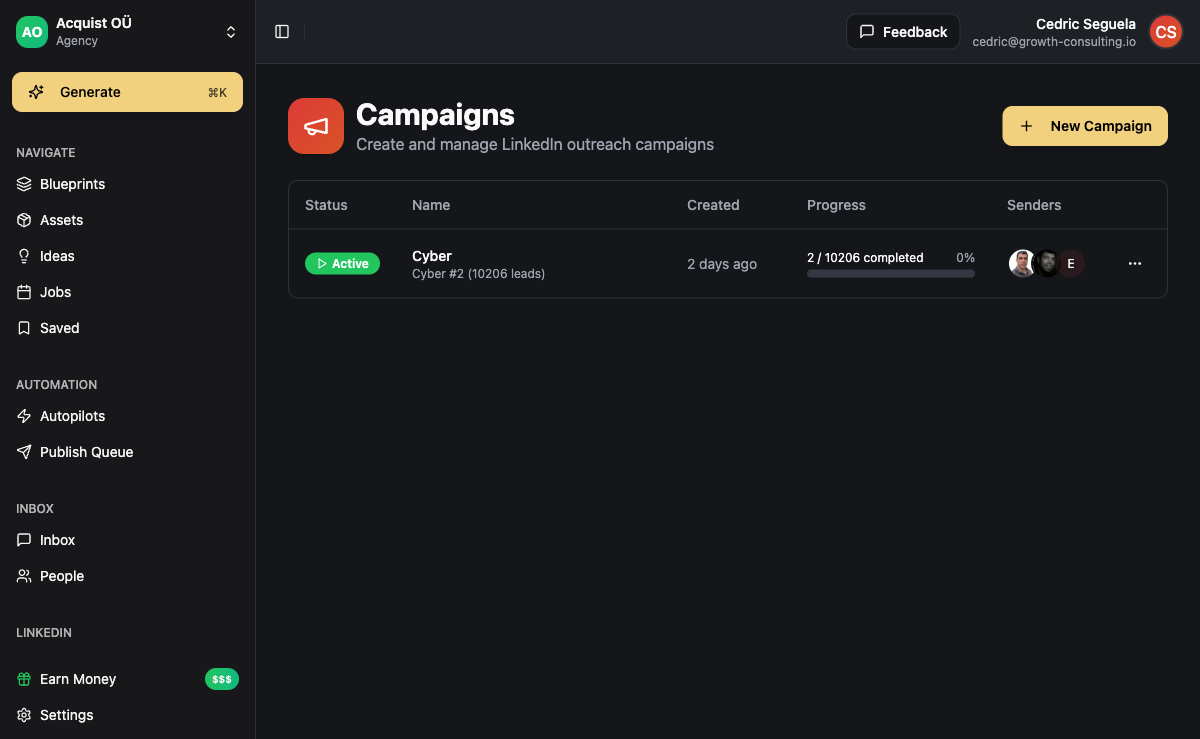
ACA is not a pure-play AI SDR platform. It is a broader platform that includes AI SDR-like capabilities as part of its multi-channel outreach and content system. The AI agent works across LinkedIn, Email, WhatsApp, Instagram, Telegram, and SMS — more channels than any dedicated AI SDR platform. It includes AI-driven prospecting via Apify integration, personalized message generation, automated follow-up sequences, reply handling, and meeting booking. The critical difference: ACA also generates AI content (posts, carousels, newsletters), has a native CRM with ICP scoring, and supports full white-labeling for agencies. It runs on a BYOK (Bring Your Own Key) model where you connect your own AI API keys and pay actual usage costs — typically $50-80/month total, regardless of the number of users or clients.
Tradeoff: ACA does not have a built-in 600M+ lead database like some dedicated SDR platforms. It relies on Apify for lead sourcing at pay-per-search pricing. It also does not have enterprise compliance certifications (SOC 2, GDPR compliance documentation) that large companies require. For agencies and growth-stage companies, these tradeoffs are acceptable; for Fortune 500 procurement teams, they are not.
How to Choose Your AI SDR Platform
Choosing the wrong AI SDR platform wastes months of setup time and thousands in subscription costs. Here is a decision framework based on what we have seen work across dozens of deployments.
Step 1: Define your non-negotiables
- How many channels do you need? (Email only? LinkedIn? WhatsApp? All of the above?)
- Do you need native CRM or are you integrating with an existing one?
- Do you need white-label / reseller capability? (Only relevant for agencies)
- What is your budget per seat or per AI agent per month?
- Do you need enterprise-grade compliance or can you operate without it?
Step 2: Match your profile
| Your Profile | Best Platforms |
|---|---|
| Solo founder, small team, tight budget | ACA (BYOK, flat pricing), Clay (if you have time to configure) |
| Mid-market sales team (5-20 reps) | 11x.ai, Artisan, Regie.ai, Quickchat |
| Enterprise with compliance requirements | Regie.ai, Amazon Q |
| Agency reselling outreach services | ACA (white-label, multi-channel, content included) |
| Data-heavy, research-first outreach | Clay |
Common Mistakes When Buying an AI SDR Platform
The number one mistake we see: buying the platform before cleaning the data. An AI SDR platform is only as good as your ICP definition, your lead list quality, and your messaging framework. Teams that skip the prep and expect the AI to figure everything out end up spending months chasing bad data.
The second mistake: underestimating the human-in-the-loop requirement. Even the best AI SDR platforms generate responses that need occasional review — not every reply, but the nuanced ones. A prospect who asks a complex technical question, raises a legal concern, or tries to negotiate the meeting format needs a human. If you deploy an AI SDR and walk away entirely, you will lose deals.
The third mistake: choosing a platform with fewer channels than your prospects use. If your ICP responds on LinkedIn but not email, an email-only AI SDR is nearly useless. Check which channels your best prospects actually use before committing to a platform that limits your reach.
Frequently Asked Questions
What is an AI SDR platform?
An AI SDR platform is a software agent that automates the prospecting, outreach, follow-up, qualification, and meeting-booking work of a human Sales Development Representative. It uses LLMs to research prospects, write personalized messages, send them across email and/or LinkedIn, handle replies, and book meetings — all without direct human involvement in each step.
Can an AI SDR close deals?
No. AI SDR platforms are designed to book meetings, not close them. Closing a deal involves negotiations, procurement conversations, product demos, and relationship building — all of which require human judgment and trust. The AI SDR hands off a qualified lead to a human salesperson after the meeting is scheduled.
How much does an AI SDR platform cost?
Pricing varies widely by platform. Entry-level platforms range from $50-200/month (ACA, basic Clay setup). Mid-market platforms like 11x.ai and Artisan start at $500-2,000/month per AI agent. Enterprise platforms like Regie.ai and Amazon Q start at $1,000-2,000/month with annual commitments and minimum seat requirements. The common thread: AI SDR pricing does not scale linearly with usage the way human SDR salaries do. A single AI agent costs a fraction of a human SDR's salary and works 24/7.
Do AI SDR platforms work for B2B?
Yes, and that is where they perform best. B2B sales cycles where the ICP is well-defined, decision-makers are active on LinkedIn and email, and the purchase involves multiple touches over time are ideal. AI SDR platforms struggle with B2C or transactional sales where volume and speed matter more than personalization.
What channels do AI SDR platforms support?
It depends on the platform. Most support email and LinkedIn at minimum. Some (ACA, UserGems) extend to WhatsApp, Instagram, Telegram, SMS, and phone calls. Clay focuses on email and LinkedIn. Regie.ai and 11x.ai support email and LinkedIn with limited WhatsApp or phone. Before buying, confirm which channels your ICP actually engages on and whether the platform supports them natively.
How many meetings should I expect from an AI SDR per month?
In our experience, 30-50 qualified meetings per month per AI agent is a realistic target for well-configured platforms in B2B markets. That number depends heavily on list size, ICP definition, message quality, and follow-up sequencing. Below 10 meetings per month suggests a problem with one of those inputs — not necessarily a problem with the platform itself.