Accountants and bookkeeping firms need a steady flow of new clients, but most rely on referrals and local ads. Cold email gives you direct access to business owners who need tax prep, bookkeeping cleanup, or year-end planning — right when they are most likely to buy. This guide delivers ready-to-use templates and a multi-channel approach that turns outreach into booked calls.
Short answer: Cold email for accountants works when you target business owners during their busiest seasons — tax season, year-end close, quarterly deadlines — and offer immediate relief. A 4-email sequence with LinkedIn follow-up can generate a 10-15% reply rate from bookkeeping prospects. Use the templates below to start today.
Why Cold Email Works for Accountants
Accountants have a seasonal sales problem. During tax season (January to April) and year-end (October to December), demand spikes — but so does competition. Cold email lets you reach decision-makers before they pick a firm, while they are already stressed about deadlines and compliance.
Traditional accounting marketing relies on:
- Referrals — slow, unpredictable, and capped by your existing network
- Google Ads — expensive per click, especially for competitive keywords like "CPA near me"
- Networking events — time-intensive with low ROI for most firms
Cold email flips the model. You go to the prospect instead of waiting for them to find you — and you go with a message that addresses their specific pain point (overwhelmed with bookkeeping, dreading tax season, need a second set of eyes before year-end).
Reply rate benchmark: Well-targeted cold email sequences for accounting services land between 8% and 18% reply rate in our experience, with the highest response coming during the 4 weeks before major tax deadlines. Sequences that include LinkedIn connection requests between emails see 20-40% higher engagement than email-only campaigns.
The Seasonal Hook: Timing Your Outreach
The best cold email for accountants is the one that arrives at the right moment. Accounting prospects have a predictable buying cycle tied to deadlines.
| Season | Timing | Prospect Pain | Your Angle |
|---|---|---|---|
| Tax season prep | January - March | Missing documents, unsure of deductions, late filings | "We handle the prep while you focus on running your business" |
| Tax season extension | March - April 15 | Panic filing, missed deadlines, stress | "Last-minute tax help — extensions filed same day" |
| Year-end planning | October - December | Quarterly estimates, tax liability surprises, compliance | "Save on taxes by reviewing your Q4 structure now" |
| Bookkeeping clean-up | Any month | Messy books, late reconciliations, inventory errors | "I can clean up your Q3 books in 3 days — guaranteed" |
Send your first email 4-6 weeks before a deadline. That is when prospects are most open to help — early enough to act, late enough to feel the pressure.
5 Cold Email Templates for Accountants (2026)
These templates are designed to be personalized for each prospect. Replace bracketed fields with the prospect's specific situation. Keep the tone professional but direct — like a fellow business owner who gets their pain.
Template 1: Tax Season Relief (January-March)
Subject: Tax season stress? I can handle your [business type] prep
Hi [First Name],
Tax season is here, and I know you are busy running [Company Name]. The last thing you need is to chase down receipts and figure out deductions while trying to keep the business moving.
We work with [industry] businesses every year to handle their full tax prep — from organizing documents to filing extensions. Most of our clients send us their year-end file and get their return in 10 days.
Would a quick 10-minute call this week make sense? I can show you exactly how we handle the heavy lifting.
Best,
[Your Name]
Template 2: Year-End Planning (October-December)
Subject: Your tax bill next April? Let's review it now
Hi [First Name],
It is October, and most business owners are focused on Q4 revenue — not their tax liability. But the ones who plan now save thousands in April.
I can review your year-to-date numbers and spot potential surprises before they become problems. Things like:
- Underpaid quarterly estimates
- Missed deductions from recent equipment purchases
- Entity structure changes that could save taxes
Want me to take a look? No cost, no strings — just a second set of eyes before Q4 closes.
Best,
[Your Name]
Template 3: Bookkeeping Clean-Up (Any Time)
Subject: [Prospect Company]'s books — a quick audit?
Hi [First Name],
Honest question: when was the last time your books were fully reconciled?
Most business owners we talk to are 2-3 months behind on bookkeeping. It is not laziness — it is just too easy to push "later" when you are focused on growth. But messy books mean inaccurate P&Ls, tax filing stress, and potential compliance issues.
We can clean up your last quarter in under 3 days. Flat fee, no surprises.
Interested in a 5-minute call to see if it is a fit?
Best,
[Your Name]
Template 4: Referral-Based Outreach (Warm Intro)
Subject: [Mutual Connection] suggested I reach out
Hi [First Name],
[Mutual Connection] mentioned you might be looking for a solid accounting firm — or at least someone to handle tax season overflow. She has been with us for [time period] and thought we could help you too.
We focus on [industry] businesses, so we already know the common deductions, compliance quirks, and software your team uses.
Would a quick call next week work for you?
Best,
[Your Name]
Template 5: Growth-Focused (For Larger Firms)
Subject: Scaling [Prospect Company]'s accounting support
Hi [First Name],
As your business grows, your accounting needs get more complex. You might be outgrowing your current bookkeeper or just realizing you need a full-service firm that can handle tax planning, CFO advisory, and payroll — not just compliance.
We work with companies like yours to build a scalable accounting stack — from tech setup to fractional CFO services. No more chasing receipts in Q4.
Worth a 15-minute chat?
Best,
[Your Name]
The Multi-Channel Advantage: LinkedIn + Email
Email alone works, but adding LinkedIn into the sequence increases reply rates significantly. Here is why:
- LinkedIn connection requests are seen as warmer than cold email — the prospect knows you found them specifically
- A LinkedIn profile visit + message creates a "digital handshake" that makes your email feel less cold
- You can follow up with a LinkedIn message if email goes unanswered, giving you a second touchpoint without looking desperate
A simple multi-channel sequence for accountants might look like this:
| Day | Channel | Action |
|---|---|---|
| Day 1 | Send a personalized connection request (no message, just the invite) | |
| Day 3 | Send Template 1 (Tax season relief) or Template 3 (Bookkeeping clean-up) | |
| Day 7 | If connected, send a short LinkedIn message: "Hey [Name], did you see the email I sent on [topic]? Worth 5 minutes?" | |
| Day 10 | Send Template 5 (Growth-focused) — different angle, same value proposition |
This multi-channel approach works because each touch feels intentional rather than automated. The prospect gets a sense you actually researched them — which you should.
Building Your Target List
Your cold email is only as good as the list you send it to. For accounting firms, the best prospects are:
- Small to medium business owners (10-100 employees) — they have enough complexity to need ongoing support but not enough to have a full-time CFO
- E-commerce companies — inventory accounting, sales tax nexus, and multi-state compliance are pain points
- Professional services firms — lawyers, consultants, agencies who bill hourly and need accurate P&L tracking
- Medical offices and dental practices — complex billing, insurance reconciliation, and payroll needs
- Real estate investors — rental income, depreciation schedules, 1031 exchanges
Use LinkedIn Sales Navigator to filter by industry, company size, and job title ("Owner", "CEO", "Partner"). Export your matches and verify email addresses using a tool like Apify B2B Lead Finder — expect 70-80% accuracy on well-verified lists.
Compliance Notes for Accounting Cold Email
CPA firms and accounting practices are regulated differently than general businesses. A few things to keep in mind:
- CAN-SPAM compliance: Every email must include a clear unsubscribe link and your physical mailing address. Honest opt-outs are non-negotiable.
- State board rules: Some state CPA boards restrict direct solicitation. Review your state's rules before launching. Generally, B2B outreach is fine; B2C tax prep marketing may have more restrictions.
- Confidentiality: Do not reference any specific financial data about the prospect in your outreach unless you have explicit permission. Keep your messaging about their general pain points.
Metrics That Matter for Accounting Campaigns
Track these numbers to know if your cold email for accountants is working:
- Open rate: Accounting cold emails tend to open at 40-55% — higher than average because the subject line ("tax") grabs attention during tax season
- Reply rate: The single most important metric. Aim for 8-15% reply rate on your first sequence. Below 5% means your targeting or copy is off
- Meeting booked: 2-5% of total emails sent should turn into a booked call
- Cost per meeting: With BYOK pricing, a well-optimized sequence can cost $5-15 per booked meeting including all tools and email accounts
Frequently Asked Questions
Is cold email legal for accountants?
Yes, cold email for B2B services is legal under CAN-SPAM in the US. Every email must include an unsubscribe link and your business address. Some state CPA boards have specific rules about direct solicitation — always check your state's regulations before launching a campaign. General B2B outreach to business owners is almost always allowed.
What is the best time to send cold emails to accounting prospects?
During tax season (January-April), send early in the week — Monday or Tuesday morning — when business owners are most stressed about deadlines. For year-end planning (October-December), aim for mid-week (Wednesday-Thursday) when they are looking ahead. Avoid sending on weekends or late Friday afternoons.
How many follow-ups should I send?
Two to three follow-up emails plus one LinkedIn message is the sweet spot. More than 4 touches and you risk being marked as spam. Space them 3-4 days apart. Each follow-up should offer a new angle — not just "did you see my last email?"
Should I offer a free consultation in my cold email?
Yes, a free 15-minute call with no strings attached is the highest-converting call-to-action for accounting services. Prospects want to know you understand their situation before they commit. The call is the close — use it to diagnose their problem and present your solution.
Can ACA help me manage multi-channel campaigns for accounting clients?
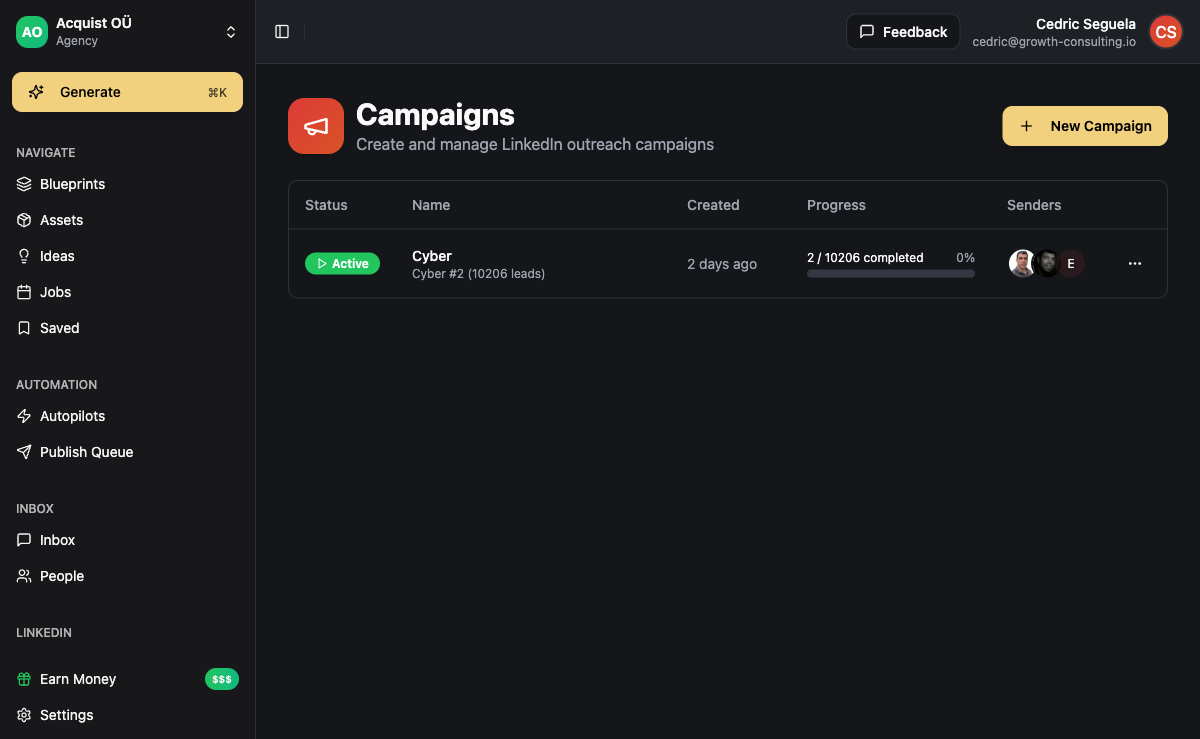
ACA's campaign builder handles email and LinkedIn sequences from one interface, with a unified inbox for all replies. The visual drag-and-drop editor lets you set branching logic — if a prospect books a call, they stop receiving emails. If they ignore LinkedIn, the sequence moves to email automatically. For accounting firms running campaigns for multiple practice areas, ACA's workspaces keep each niche separated.