Cold email for financial advisors lives in a compliance minefield. Every message you send must pass FINRA review, avoid SEC restrictions, and still sound human enough to book a call. Most generic cold email advice will get you flagged or fined. This guide gives you FINRA-compliant templates that work, the approval workflow you need, and a multi-channel strategy that keeps your outbound legal.
Short answer: Yes, financial advisors can send cold email under FINRA and SEC rules — but every message must be pre-approved by a registered principal, include specific disclosures, avoid any promise of returns, and be sent from an approved system that retains a copy. The cost of non-compliance (fines up to $50,000+ per incident) means you cannot treat this like standard B2B outreach. The templates below are built to pass compliance review while still earning a reply.
The Compliance Landscape for Financial Advisors
Before you write a single subject line, you need to understand the rules. FINRA Rule 2210 governs communications with the public. SEC Rule 206(4)-1 covers marketing by investment advisers. The overlap creates specific requirements for cold email:
- Pre-approval: Every email sent to 25 or more recipients (even across a campaign) must be pre-approved by a registered principal under FINRA Rule 2210(b)(1). Some firms require pre-approval for every message regardless of list size. Know your firm's written supervisory procedures.
- Recordkeeping: You must retain copies of all outbound emails for at least three years, with the first two in an accessible place. SEC Rule 204-2 and FINRA Rule 4511 require this.
- No promises: You cannot claim or imply a guarantee of results, past performance, or future returns. Even phrases like "many of our clients have seen success" can trigger a compliance flag.
- Testimonials: As of SEC Marketing Rule amendments effective November 2022, you can use testimonials — but only if you disclose whether the person was compensated and ensure the testimonial is not misleading. Most compliance officers still prefer to avoid them in cold outreach.
- Opt-out: Every email must include a clear, functional unsubscribe mechanism. FINRA interprets this as a requirement for all commercial email.
One warning letter from FINRA for a non-compliant email can cost you weeks of back-and-forth, legal fees, and client trust. The cost of doing it right is a 24-hour approval delay. The cost of doing it wrong is your license.
The Approval Workflow Every Advisor Needs
Most advisors skip this step and pay for it later. Here is the workflow that keeps your outbound campaign compliant from day one:
- Write your sequence — 3 to 5 emails using the templates below. Keep each email under 150 words.
- Submit for pre-approval — send the entire sequence (subject lines included) to your firm's registered principal or compliance officer. Attach a brief note on the target audience (e.g., "business owners with $1M+ in investable assets in the tri-state area").
- Document the approval — get written approval (email is fine). Store it alongside the approved version of each email.
- Send from an approved system — use a platform that automatically archives sent emails and records unsubscribes. ACA's campaign builder logs every message and provides a searchable archive by campaign and recipient.
- Review monthly — pull your sent log once per month. Check for any manual edits that deviated from the approved version. If you spot one, report it to compliance immediately.
This workflow takes 24 to 48 hours for the first campaign. After that, most compliance officers will approve new sequences in hours because they trust your process.
FINRA-Compliant Cold Email Templates That Book Calls
These templates are written to pass compliance review while still sounding like human outreach. They avoid performance language, use no testimonials, and include the required opt-out language. Each one is under 150 words — short enough to be read on mobile, long enough to establish relevance.
Template 1: The Relevance Opener
Subject: A thought on [Prospect's Industry/Business Type]
Hi [First Name],
I work with [industry/business type] owners who are preparing for changes in the [relevant regulation or market condition, e.g., "interest rate environment" or "tax code sunset at end of 2025"].
Many of them tell me they are unsure how to adjust their personal and business financial strategy without triggering an unnecessary tax event.
I'd be happy to share what I'm seeing across my client base if you're open to a 15-minute conversation — no commitment, no pitch for anything specific.
If this doesn't apply, just reply "pass" and I won't follow up on this topic.
Best,
[Your Name]
[Firm Name]
[Phone Number]
[Compliance tagline, e.g., "Securities offered through [Broker-Dealer], Member FINRA/SIPC"]
If you would like to opt out of future emails, click here: [Unsubscribe Link]
Template 2: The Planning Question
Subject: A quick question about your [topic] planning
Hi [First Name],
Quick question — do you currently have a written [retirement / estate / tax] plan that you review annually with a financial professional?
Most of the business owners I speak with have a CPA and a lawyer but no coordinated financial plan that ties personal goals to business strategy. The gaps I see most often are [specific gap relevant to their situation, e.g., "cash flow modeling for a future exit"].
If you'd be open to a 15-minute call to compare notes, let me know. If not, no hard feelings.
Best,
[Your Name]
[Compliance tagline]
[Unsubscribe Link]
Template 3: The Event-Based Follow-Up
Subject: Following up on [specific event, e.g., "the Fed meeting last week"]
Hi [First Name],
I followed up with you a few weeks ago about financial planning for [business type] owners. I realize timing might not have been right.
Given the [specific event, e.g., "Fed rate decision last week"], I wanted to circle back in case you are evaluating whether your current strategy still fits your goals. No assumption that anything needs to change — but many of my clients find it helpful to have a fresh set of eyes on their plan periodically.
Happy to do a complimentary 15-minute review if that interests you.
Best,
[Your Name]
[Compliance tagline]
[Unsubscribe Link]
Cold email reply rate for financial advisors: In our experience working with advisory firms running compliant cold outreach, well-targeted sequences using the templates above land reply rates between 8% and 18% — significantly higher than generic B2B cold email (which benchmarks around 3-5%). The difference is relevance: when your email speaks to a specific regulatory or planning challenge the advisor's ICP actually faces, compliance becomes an advantage rather than a barrier.
What to Avoid in Every Email
These phrases and patterns will get your email rejected by compliance — or worse, flagged by FINRA on a routine review:
| Category | Examples to Avoid | Safe Alternative |
|---|---|---|
| Promises of returns | "Earn X% more", "Guaranteed growth", "Beat the market" | "Consider whether your current strategy fits your goals" |
| Past performance | "Our fund returned X% last year", "We've delivered X% returns for clients" | Delete entirely. Provide no performance data in cold outreach. |
| Testimonials without disclosure | "Client John saved $XX using our strategy" | Don't use client stories in cold email unless you have written consent AND compensation disclosure per SEC Marketing Rule. |
| Urgency without basis | "Act now before rates change", "Limited spots available" | Use real deadlines: "The tax provisions in the Tax Cuts and Jobs Act sunset at end of 2025 — thought you might want to evaluate before then." |
| Client testimonials | "John from [City] says we helped him..." | Avoid entirely in cold sequences. Save testimonials for follow-up materials after the first meeting. |
| Personalized return claims | "Based on your situation, you could save X" | "We can review your current strategy and identify potential areas for consideration." |
LinkedIn Outreach as a Compliant Alternative
One of the strongest advantages of multi-channel outreach for financial advisors is that LinkedIn messages are not governed by the same strict rules as email under FINRA. FINRA Rule 2210 applies to "communications with the public" but LinkedIn connection requests and InMail operate in a grey area — many compliance officers treat them as "correspondence" (less regulated) rather than "retail communications" (more regulated).
This does not mean you can say anything on LinkedIn — false or misleading statements are still prohibited by SEC Rule 10b-5. But the approval process is often lighter. In practice:
- Connection requests — generally do not require pre-approval in most firms, because they are a two-way communication (the prospect must accept before you can message further).
- InMail — may or may not require pre-approval depending on your firm's policies. Some treat it like email. Others treat it like a phone call.
- LinkedIn posts — definitely regulated. Content you post publicly is treated as a retail communication and must be pre-approved by a principal.
Multi-channel campaigns that start with a LinkedIn connection request (low or no compliance friction) and then move to email (higher friction but fully approved) give you a warm introduction before your email lands. A prospect who just accepted your LinkedIn connection is significantly more likely to open and reply to your approved email sequence.
Building Compliant Multi-Channel Campaigns for Financial Advisors
A single-channel email sequence for financial advisors has a ceiling: compliance approval takes time, and if the email goes to spam you have no fallback. Multi-channel outreach solves this by giving you multiple ways to reach a prospect while keeping each channel within its own compliance framework.
A sample compliant campaign sequence:
- Day 1 — LinkedIn connection request (low compliance friction) with a personalized note: "I work with [industry] founders on financial planning. Would be great to connect."
- Day 3 — Approved email #1 (The Relevance Opener) — sent after the LinkedIn request so the prospect recognizes your name.
- Day 7 — LinkedIn follow-up if connection was accepted: short message referencing the email, asking if timing works for a call. If connection not accepted, move to next step.
- Day 10 — Approved email #2 (The Planning Question) — the prospect now has seen your name 2-3 times, which multi-channel campaigns reliably outperform single-channel in reply rates.
- Day 15 — Final approved email (The Event-Based Follow-Up) — tied to a real market or regulatory event.
Tracking and Compliance Logging
Your compliance officer needs to be able to pull up any email from any campaign within minutes and see three things: (1) the exact version that was sent, (2) who received it, and (3) whether the recipient has opted out. Most email outreach tools do not provide this level of auditability out of the box.
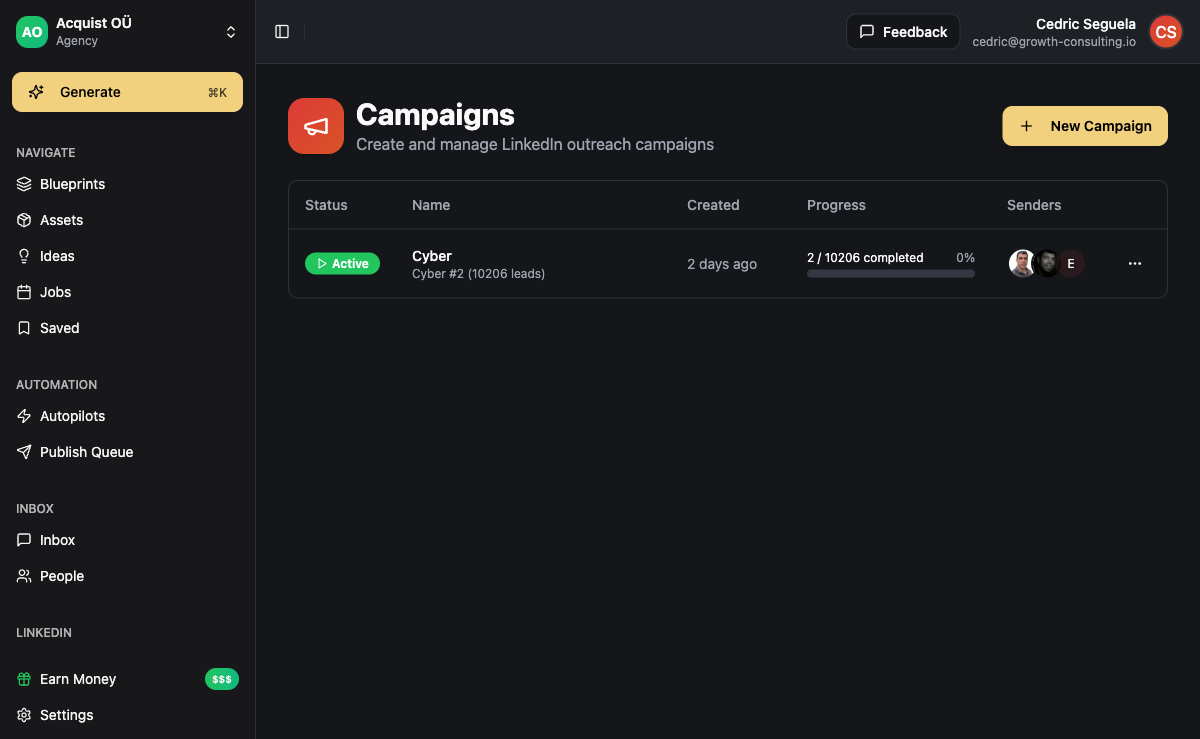
ACA's campaign builder is designed with this in mind. Every message sent through the platform is logged with a timestamp, the full body text (including the approved version), the recipient's response status, and unsubscribe records. You can generate a campaign export in seconds and hand it to compliance. This is not a feature you want to discover you need after a FINRA exam request.
What your compliance log should contain:
- Campaign name and creation date
- Approved email copy (linked to the approval email from your principal)
- Full recipient list with dates sent
- Bounce and unsubscribe records
- Reply threads (if any) for each recipient
- Any edits or changes made to the sequence (your system should store versions)
Without a logging system, you are building your practice on a risk that will eventually surface. The question with FINRA is not if you will be examined, but when. A clean audit trail turns a potential compliance problem into a five-minute document pull.
Frequently Asked Questions
Is cold email legal for financial advisors under FINRA rules?
Yes — cold email is legal for financial advisors under FINRA and SEC rules, provided every email is pre-approved by a registered principal, includes proper disclosures and a functional opt-out, avoids promises of returns or past performance, and is archived for at least three years. The rules are outlined in FINRA Rule 2210 and the SEC Marketing Rule. A campaign built within these rules is fully compliant.
Does every cold email need pre-approval from a principal?
For most financial advisory firms, yes — any email sent to 25 or more recipients (even across a campaign) must be pre-approved by a registered principal under FINRA Rule 2210(b)(1). Some firms require pre-approval for every email regardless of list size. Check your firm's written supervisory procedures (WSPs) before launching any campaign.
Can I use client testimonials in cold email?
Under the SEC Marketing Rule (effective November 2022), you can use testimonials — but you must disclose whether the person was compensated and ensure the testimonial is not misleading. Most compliance officers advise against using testimonials in cold outreach because the disclosure requirements are complex and the risk of misunderstanding is high. Save testimonials for one-on-one meetings after the prospect has engaged.
What should I include in every cold email for compliance?
At minimum: (1) your full name and firm name, (2) the compliance tagline required by your broker-dealer or firm (typically "Securities offered through [Firm], Member FINRA/SIPC"), (3) a visible, functional unsubscribe link, (4) no promises of returns, past performance, or guarantees of any kind.
Can I use LinkedIn outreach as a bypass for email compliance?
Not exactly. LinkedIn connection requests generally face less regulatory friction — many firms do not require pre-approval for connection requests or InMail. However, LinkedIn posts, comments, and InMail that contain investment advice or recommendations are subject to the same FINRA 2210 standards. The safest approach is to have a compliance-approved email sequence backed by LinkedIn outreach for warm introductions, not as a compliance loophole.
How long does compliance approval take for a cold email campaign?
If you submit a clear, pre-built sequence with 3-5 emails under 150 words each and a defined target audience, most compliance officers will approve within 24-48 hours. A 3-email sequence where every email uses one of the templates above and avoids all compliance red flags typically moves fastest. The first campaign takes the longest — your compliance officer is learning your process. Subsequent campaigns often get approved in hours.
What happens if I send a non-compliant cold email?
The consequences range from a compliance warning (and mandatory retraining) to fines of $5,000-$50,000 per violation under FINRA sanctions guidelines, depending on severity and whether it is a repeat offense. In extreme cases, non-compliance can lead to suspension or loss of license. The SEC can also bring separate enforcement actions for violations of the Marketing Rule or anti-fraud provisions. The risk profile is serious enough that it justifies the 24-hour approval delay.