Cold email for insurance agencies is the most direct way to book policy reviews with business owners who already have coverage but have never had their plan audited. Most insurance agents rely on referrals and phone calls, leaving thousands of qualified prospects untouched. This guide covers the scripts, sequences, and technical setup that insurance agencies use to turn cold outreach into booked appointments.
Short answer: Cold email for insurance agencies works when you target business owners mid-renewal cycle, lead with a specific compliance or coverage gap relevant to their industry, and use multi-channel follow-up (LinkedIn, email, WhatsApp) to get a response. The best performing scripts book 5-15 policy review meetings per 1000 contacts, use a 4-6 step sequence, and avoid insurance jargon in the first email. Below are the exact templates and the system to run them.
Why Cold Email Works for Insurance Agencies
Insurance is a relationship business, but relationships start with being seen. B2B insurance buyers — business owners, HR directors, and CFOs — are actively searching for better coverage, lower premiums, and compliance guidance. They just aren't calling you first. Cold email reaches them in their professional inbox, alongside the other vendors and partners they already evaluate via email.
What makes insurance different from other cold email verticals:
- High value per policy: A single commercial lines policy review can lead to premiums worth $2,000-$20,000 annually.
- Recurring revenue model: Most general liability and workers comp policies renew annually. Acquire one client and you have a yearly commission stream.
- Compliance triggers: Regulatory changes, new employment laws, and industry-specific risks give you a reason to reach out that isn't just selling insurance.
- Direct competition is lazy: Most insurance agencies still rely on referrals and cold calling. Email outreach with a professional multi-channel approach puts you in a category of one in your market.
Who to Target: Commercial Lines + Group Benefits Prospects
Cold email for insurance agencies works best with two distinct buyer personas. Picking the wrong one wastes your sequence.
Commercial Lines Decision Makers
These are business owners, operations managers, or CFOs with authority over general liability, professional liability, workers comp, and commercial auto policies. Target by SIC code, revenue band, and employee count. Businesses with 5-50 employees are the sweet spot — big enough to need real coverage, small enough to have a single decision maker.
Group Benefits Decision Makers
HR directors, benefits administrators, and company owners who manage health insurance, 401(k) plans, and voluntary benefits. These prospects are usually found at companies with 10+ employees. The renewal cycle is often January or July, making timing critical.
| Segment | Decision Maker | Targeting Signals | Average Policy Value |
|---|---|---|---|
| Commercial Lines | Owner / CFO | Revenue over $500K, 5+ employees, specific industry | $2K - $15K annual premium |
| Group Benefits | HR Director / Owner | 10+ employees, up for renewal within 90 days | $5K - $50K annual premium |
The 4-Step Email Sequence That Books Policy Reviews
Insurance is a trust-based purchase. You cannot send one email and expect a booked call. The sequence below uses four touches over 14 days, escalating from value to specific compliance triggers to a direct ask.
Step 1: The Compliance Trigger Email
Subject: Q3 compliance check for [Company Name]?

Hi [First Name],

Most business owners I talk to assume their commercial package policy covers everything. Then a regulatory change or a new client contract exposes a gap.

I put together a 3-minute audit that checks your current coverage against common gaps in the [Industry] space — things like cyber liability exclusions, sub-contractor coverage, and employment practices exposure.

Worth a quick look?

[Link to audit landing page]

Best,
[Your Name]
Step 2: The Risk Alert Email
Subject: New compliance requirement affecting [City] businesses

Hi [First Name],

If you haven't reviewed your [Type] policy since [Year] — you might be carrying risk that your business isn't covered for.

A few things that have changed since then:
- [Regulatory change relevant to their industry]
- common employment practices claims
- [Specific risk for their region]

I do these no-pressure reviews for 3-4 business owners a week. Happy to look at yours if you're curious where you stand.

[Calendar link: 15 min call]

Best,
[Your Name]
Step 3: The Social Proof Email
Subject: [Client Name] — similar business, same concern

Hi [First Name],

Last month I reviewed coverage for [Client Name in similar industry] and found they were overpaying by 18% on their workers comp premium AND missing a critical professional liability rider.

We fixed both within two weeks. They saved $4,200/year.

I'm not saying you have the same issue. But the only way to know is to look.

Are you open to a 10-minute chat this week?

[Calendar link]

Best,
[Your Name]
Step 4: The Direct Ask Email
Subject: One last thought on your insurance

Hi [First Name],

I sent a few emails about reviewing your current coverage — maybe not the right time, and that's fine.

Insurance is one of those things nobody thinks about until they need it. And by then it's too late.

I keep 2-3 slots open each week for quick policy reviews with no strings attached. If you ever want a second set of eyes on your policies, the offer stands.

No pitch. Just an honest assessment.

[Calendar link]

Best,
[Your Name]
Insurance cold email reply rate benchmark: In our experience, the compliance trigger email (Step 1) generates the highest reply rate at 8-12%, followed by the direct ask at 5-8%. The risk alert and social proof emails typically land between 3-6% each. A full 4-step sequence averages 12-18% reply rate across all steps. Booked policy review rate from replies: 30-40%.
Multi-Channel Follow-Up: Why Email Alone Isn't Enough
Email deliverability is getting harder. Google and Yahoo's 2024 authentication requirements mean even well-targeted cold emails land in spam if your domain reputation is poor or you send too many. Adding LinkedIn and WhatsApp follow-ups increases your reach by 40% and keeps your email volume per prospect low enough to protect sender reputation.
Best multi-channel sequence for insurance:
- Day 1: Compliance trigger email (Step 1)
- Day 3: LinkedIn connection request + personalized note referencing the email
- Day 5: WhatsApp follow-up (if number available) with a single question about renewal timeline
- Day 8: Risk alert email (Step 2)
- Day 11: LinkedIn message reinforcing the compliance point
- Day 14: Direct ask email (Step 4)
ACA handles this automatically. The visual sequence builder fires the right message on the right channel at the right interval. No manual switching between tools.
Deliverability Tips for Insurance Agencies
Insurance is a regulated industry. Certain terms can trigger spam filters and compliance flags if you're not careful.
- Avoid these subject line words: "free quote", "save money", "insurance quote", "lowest rates", "coverage now". These are high-trigger spam words for insurance verticals.
- Use a secondary sending domain: Your main agency domain should never send cold email. Register [agencyname]-insights.com or [agencyname]-team.com for outreach.
- SPF, DKIM, DMARC setup: All three are mandatory for Gmail and Yahoo deliverability. Configure them before sending a single campaign.
- Warm up each inbox: Start with 5-10 emails per day and scale to 40-50 over 4 weeks. ACA handles this through connected account management.
- Custom tracking domain: Use a subdomain like track.yourdomain.com for open and click tracking. Shared tracking domains are a deliverability penalty.
How ACA Automates Insurance Agency Outreach
ACA is built for agencies — both the insurance agency running outreach and the marketing agency running outreach for insurance clients. The platform consolidates everything you need into one white-labeled system.
What insurance agencies use inside ACA:
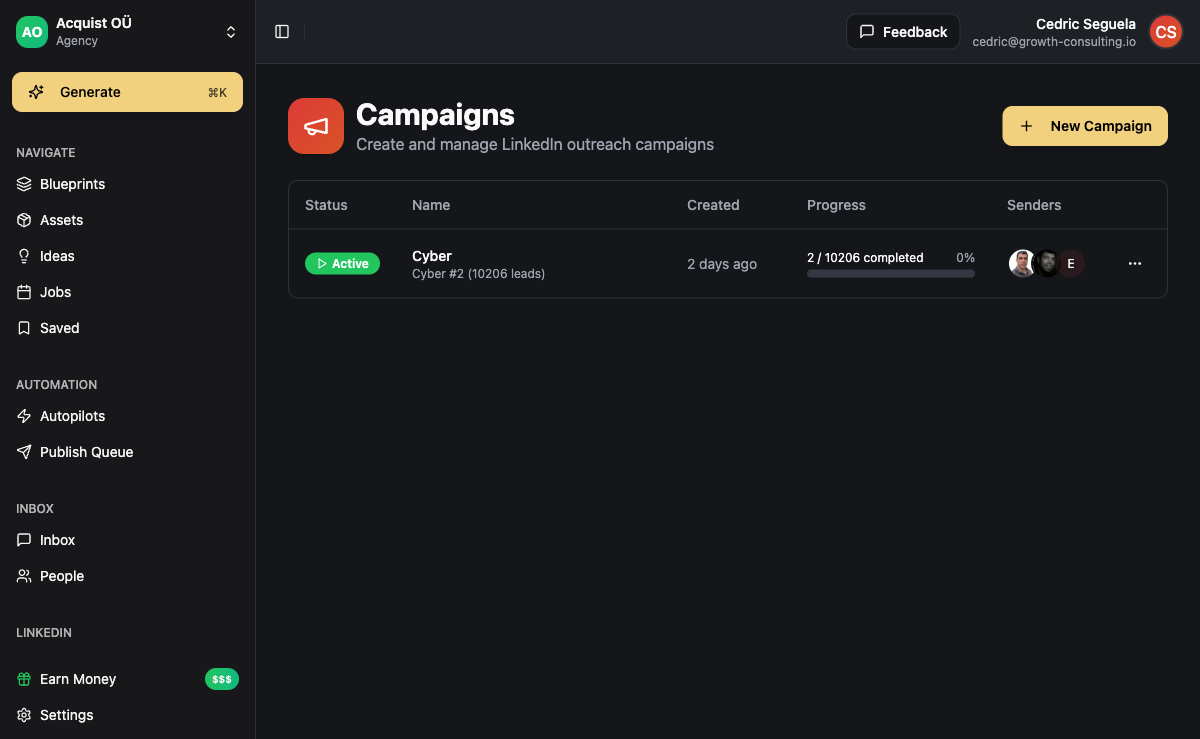
- Multi-channel sequences: LinkedIn, email, WhatsApp, SMS — all coordinated from one visual builder. Set up your 4-step policy review sequence once and let it run for every new list.
- AI content generation: Generate compliance blogs, LinkedIn posts about risk management, and newsletter content that positions you as the go-to agent in your niche.
- Unified inbox: All replies from email, LinkedIn, WhatsApp, and SMS land in one inbox. Your team responds without switching tabs.
- CRM with ICP scoring: Track every prospect through the pipeline — from cold contact to booked policy review to renewal. Score leads by revenue potential and engagement.
- White-label: If you run an agency managing outreach for insurance clients, everything is under your brand. Client workspaces are isolated. They never see ACA.
- BYOK model: Bring your own API keys and pay actual usage cost. No per-seat fees that scale with your team.
Frequently Asked Questions
What is the best subject line for insurance cold email?
The highest-performing subject lines avoid insurance jargon and focus on compliance or risk. "Q3 compliance check for [Company Name]?" and "New requirement affecting [City] businesses" consistently outperform "Insurance review" or "Policy quote" by 3-5x in open rate.
How many emails should I send per day as an insurance agent?
Start with 10-20 per day per inbox after a 4-week warm-up. Scale gradually to 40-50 per day per inbox. Above 50 per day without multiple inboxes and domains, deliverability drops sharply. A practical setup for an insurance agent: 2 secondary domains with 2 inboxes each sending 40 emails per day = 160 targeted emails per day.
Can I cold email about health insurance or group benefits?
Yes, but timing matters. Group benefits prospects are most receptive 60-90 days before their renewal date. Use intent data or trigger events (hiring announcements, company expansions) to time your outreach. ACA's ICP scoring includes custom fields for renewal date tracking.
Does ACA work for solo insurance agents or only agencies?
Both. A solo agent can run a full multi-channel campaign with 2-3 secondary domains and hit 100-200 targeted prospects per day. The BYOK model means a solo agent pays $50-80/month instead of per-seat pricing that penalizes single users.
Is cold email legal for insurance agents under TCPA and CAN-SPAM?
Yes, when you follow the rules: include a physical mailing address, a clear unsubscribe link that works within 24 hours, and identify yourself as a licensed agent. CAN-SPAM applies to commercial email. The TCPA regulates phone calls and SMS, not email. Always target B2B contacts at their business email. ACA automatically appends unsubscribe links and manages opt-out lists per campaign.