Starting an agency in 2026 is easier and harder than it has ever been. Easier because AI compresses the work that used to require a 5-person team into systems one operator can run. Harder because clients have seen every pitch, every cold email template, and every "done-for-you" promise. The agencies winning right now sell outcomes (leads, meetings, content output, pipeline) rather than activities, run lean on AI-powered tooling, and pick one niche they can dominate. This playbook walks the full journey from zero to first ten clients.
Short answer: Pick one agency model (lead generation, AI services, content, or SDR-as-a-service), commit to one niche for 12 months, build an offer that sells a specific outcome with a guaranteed timeline, run outbound across LinkedIn and email to land your first 5 clients, then productize delivery so you can serve 20+ clients without hiring a 5-person team. The whole journey from registration to first paying client can run 30 to 60 days if you skip the perfectionism phase.
Why 2026 Is Different for New Agencies
The agency playbook from 2018 does not work anymore. Hiring a junior account manager, two VAs, and a designer to deliver $2,000/month retainers used to be standard. Today, those margins do not exist. Labor costs went up, client expectations went up, and the tools that small agencies relied on (Mailchimp + Calendly + a spreadsheet CRM) cannot compete with what your clients can buy themselves on a free trial.
Three shifts make 2026 a genuinely different market:
- AI collapsed the cost of delivery. Tasks that consumed 20 hours of a junior's week (content drafts, lead research, message personalization, inbox triage) now take a properly configured system 30 minutes to run unattended. The agencies that exploit this run on profit margins that 2018 agencies could not touch.
- Single-channel outbound is dead. Cold email reply rates dropped as inbox filtering tightened. LinkedIn connect-and-pitch saturated. The agencies that book meetings now run 3 to 6 channels in coordinated sequences. You cannot sell single-channel outreach as a service anymore because prospects have tried it and watched it stop working.
- White-label became table stakes. Clients want to see your brand, not the underlying tool. Reselling a platform that prominently displays its own brand inside your dashboard is a credibility problem. The agencies winning premium retainers run on infrastructure that lets them ship their own product.
That is the landscape. The good news: if you read those three shifts as a builder rather than a victim, they are the biggest opening for new operators in a decade. The work is in picking the right model, niche, and systems from day one.
Pick Your Agency Model
The first decision is not your niche or your name. It is what you actually sell. There are four agency models that work in 2026, and they have very different economics, sales cycles, and ceilings.
Lead Generation Agency
You sell qualified leads or booked meetings. Clients pay $1,500 to $5,000 per month and you deliver a guaranteed number of qualified conversations into their calendar. Multi-channel outreach (LinkedIn, email, and often WhatsApp) does the work. This is the highest-velocity model because the outcome is measurable in week one and the value is obvious to any business that lives off pipeline.
Who it fits: Operators who like sales, can write or oversee copy, and want recurring revenue from day one. The ceiling is high (20+ clients at $3K/month is achievable solo) and the delivery is highly systemizable.
AI Agency
You sell AI-powered outcomes: content production, appointment setting, inbox automation, knowledge agents, CRM workflows. The wrapper is "we run the AI for you," and the buyer is a business owner who knows AI is happening but does not have the time to learn it. AI agencies overlap heavily with lead generation agencies in delivery but sell a wider set of outcomes. See our overview of the AI agency model and how ACA powers it.
Who it fits: Operators who can articulate value in non-technical language and who are comfortable shipping multiple service lines (content + outreach + inbox) under one offer. Margin is excellent because most of the work happens unattended.
Marketing or Content Agency
You produce content for clients on a retainer: posts, carousels, newsletters, video clips, articles. Charge $1,500 to $4,000 per month for 20 to 60 pieces of content per month, on-brand, scheduled and published. The classic content agency required a 3-person team to deliver this. AI content pipelines change the math.
Who it fits: Operators with taste for writing, design, or strategy. The downside: content alone does not produce a measurable revenue outcome for the client, which makes retention harder. Many content agencies eventually bolt outreach onto the offer to close the loop on results.
SDR-as-a-Service
You replace a client's internal sales development hire. Charge $2,500 to $6,000 per month for a fully managed pipeline development function: list building, multi-channel outreach, inbox monitoring, reply handling, meeting booking. Higher price point than lead gen because you are taking over a function rather than delivering volume.
Who it fits: Operators with B2B sales experience. The sales cycle is longer (you are replacing a hire) but contracts are stickier and command higher prices.
Pick Lead Generation if: you want fast cash flow, measurable outcomes, and the easiest sales conversation.
Pick AI Agency if: you want to bundle multiple services under one offer and capture margin from end-to-end automation.
Pick Content Agency if: you have taste and want lower-friction delivery, but plan to add outreach within 6 months.
Pick SDR-as-a-Service if: you have B2B sales chops and want premium retainers with deeper client integration.
Niche Selection Is the Biggest Lever
Once your model is set, the niche decision determines whether you grow or stall. New operators almost always pick a niche that is too broad ("B2B SaaS" or "coaches") and lose 9 months trying to differentiate. The fix is to pick a niche that is one layer deeper than feels comfortable.
A workable niche has three properties:
- Specific enough that you can name 50 prospects in 15 minutes. "E-commerce brands" fails this test. "Shopify stores selling supplements between $500K and $5M revenue" passes.
- The buyer has budget and feels pain. Pre-revenue founders do not buy. Mid-sized businesses with a sales team that is not hitting quota do.
- You can write specifically to them. If you cannot write a LinkedIn post that makes someone in this niche stop scrolling, you do not understand them well enough yet.
The fastest way to validate a niche is to write ten outreach messages that would only land for that exact segment and send them. If they generate replies, the niche is real. If they get ignored, the niche is too broad or the value prop is wrong.
Commit for 12 months minimum. The compounding effect of a focused niche shows up in months 6 to 9 when referrals start, case studies accumulate, and outbound copy gets sharp because you have written it 200 times. Operators who switch niches every quarter never reach the compounding phase.
Pricing the Offer
Pricing kills more agencies than client acquisition does. The two most common failures: charging by the hour (which caps your income at hours worked) and charging too little to leave room for delivery (which traps you in a $1,200/month retainer that costs you $900 to deliver).
Three pricing models that work
Flat retainer. The default for service agencies. Client pays $2,000 to $5,000 per month for a defined scope. Predictable for both sides. Pricing should be at least 4x your delivery cost so you have margin to invest in better systems, sales, and the inevitable scope creep.
Performance-based. You charge per qualified meeting, per lead, or per signed deal. Higher upside but high risk for new agencies because you eat the cost of underperformance. Recommended only after you have 6+ months of delivery data and can predict outcomes with confidence.
Hybrid (retainer + performance). A base retainer ($1,500 to $2,500) plus a per-outcome bonus. This is the most defensible structure once you have a track record. Clients feel the retainer is reasonable because you have skin in the game. You collect upside when delivery overperforms.
Margin benchmark for AI-powered service agencies: in our experience working with operators who use modern tooling, gross margin on a properly priced retainer lands between 70% and 85%. If you are below 50%, you are either underpriced, overstaffed, or running too many disconnected tools. Above 85% usually means you are underinvesting in retention and will lose clients in month 4.
How to land at the right number
Start at the top of what feels uncomfortable, then add 25%. If your gut says $2,000/month, your offer is $2,500. The reason: you will discount on your first 3 deals to close them. Pricing at $2,500 with a $500 discount lands you at $2,000 net. Pricing at $2,000 with the same discount lands you at $1,500, which is below the threshold where the work is worth doing.
Also: build in a setup fee. $1,000 to $2,500 paid upfront, separate from the monthly retainer. Setup fees filter unserious buyers, fund your first month of delivery cost, and signal that real work is happening before month one.
Build the Offer Around an Outcome, Not an Activity
The single biggest difference between agencies that close quickly and agencies that grind through 90-day sales cycles is the shape of the offer. Activity-based offers are commodities. Outcome-based offers with a timeline and a guarantee are premium products.
Activity-based (weak): "We send 1,000 cold emails per month and manage your LinkedIn outreach." The prospect's question: how do I know this works? You have no answer.
Outcome-based (strong): "We deliver 8 to 12 qualified sales meetings per month for B2B SaaS companies in the cybersecurity space. If we miss the floor in any month, you do not pay that month. Setup takes 14 days and first meetings land by week 3." The prospect's question is now "can you actually do this for me?" which is a much shorter conversation.
Three components every outcome-based offer needs:
- The specific outcome. Meetings, leads, content pieces, response rate, pipeline value. Not "growth" or "brand awareness."
- The timeline. When does the first result land? When does the full result land? Vague timelines kill close rates.
- The guarantee or risk reversal. Performance refund, free month, extended service. Make the buyer feel that the risk is on you, not them.
Client Acquisition: How to Get Your First 5 Clients
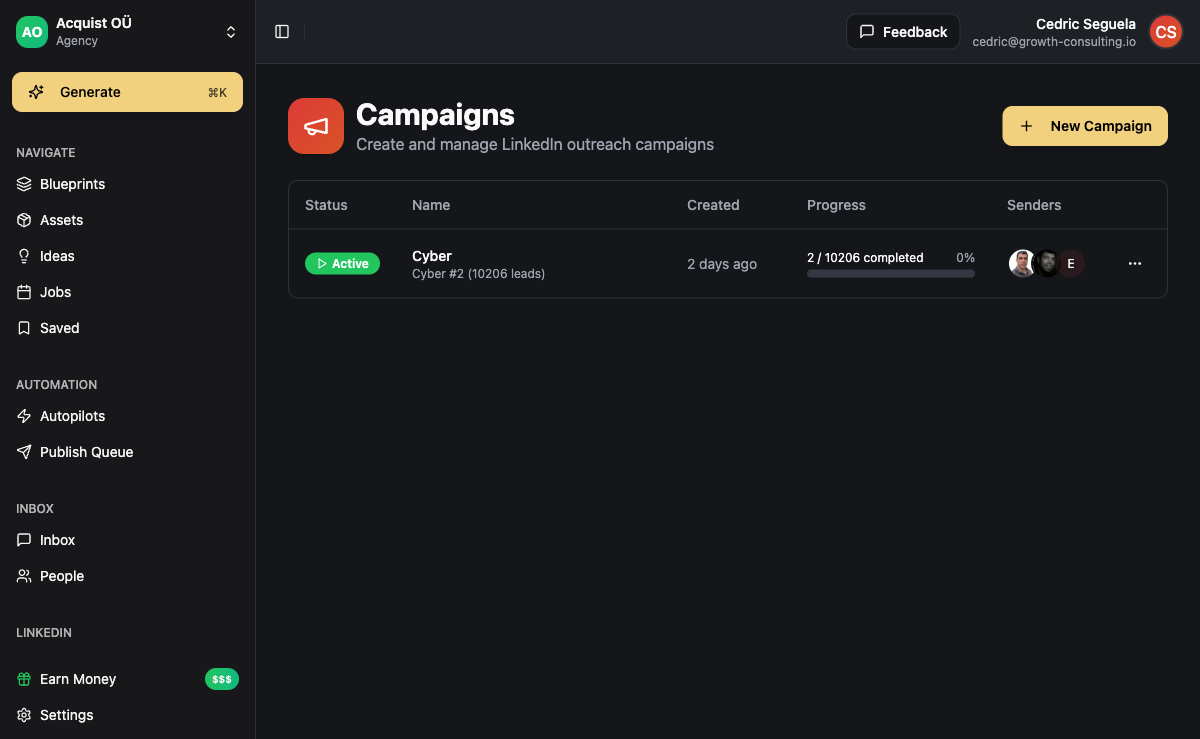
Here is the uncomfortable truth: your first 5 clients should not come from inbound. Content takes 6 to 12 months to compound. Paid ads need a tested funnel. Referrals require existing clients. The only channel that works in week 1 is outbound, and it is the same channel you will sell to your clients, so practicing on your own pipeline doubles as product development.
The first-5-clients outbound playbook
- Build a list of 500 named prospects in your niche. Not "e-commerce brands." Named people with named companies and verified contact details. Use Apify or similar B2B lead tooling to source, then verify emails.
- Set up multi-channel infrastructure. 2 to 3 secondary domains for cold email (never your primary domain), 6 to 8 warmed mailboxes, and a LinkedIn profile that looks credible. Most operators skip this step and burn their primary domain in week 2.
- Write 3 sequences. A LinkedIn-first sequence (connect, message, follow-up). An email-first sequence (3 to 4 touches over 2 weeks). A LinkedIn-to-email handoff sequence for prospects who engage on LinkedIn but do not reply.
- Send 30 to 50 multi-channel touches per day. Once your domains are warm and your sequences are loaded, this should be 15 to 30 minutes of human work per day, not 3 hours.
- Book and close. Expect 1 to 3 booked calls per 100 contacted prospects in a well-defined niche. Expect to close 20% to 40% of booked calls in your first 3 months as your discovery and pitch sharpen.
Five clients at $2,500 per month is $12,500 in monthly recurring revenue. That is the floor for a viable agency, and most operators who execute the playbook above reach it within 60 to 90 days.
Delivery Systems: What Actually Happens After They Sign
This is where most agencies die. They sell well, then drown in delivery, then stop selling, then lose clients to poor delivery, then need to sell again. The way out is to design delivery as a system from day one, not as a series of tasks you do by hand.
The 5 systems every agency needs
Onboarding system. A repeatable 7 to 14 day process: intake form, kickoff call, ICP definition, copy approval, infrastructure setup, soft launch. Document it once, run it identically for every client. Onboarding is also where churn risk is set: clients who feel chaos in week 1 will be looking for the exit in month 3.
Outreach delivery system. Per-client isolated workspaces, separate sending infrastructure per client, dedicated sequence templates that can be cloned and adjusted. Running 10 clients out of one shared workspace is how reputations get cross-contaminated and how mistakes compound. ACA's campaign builder handles this with workspace isolation by default.
Content production system (if applicable). Brand voice configured once per client, blueprint templates for each content format (post, carousel, newsletter), scheduled production on a weekly cadence. The work moves from "I write content for clients" to "I review and approve AI-generated content." 80% time savings on the delivery side.
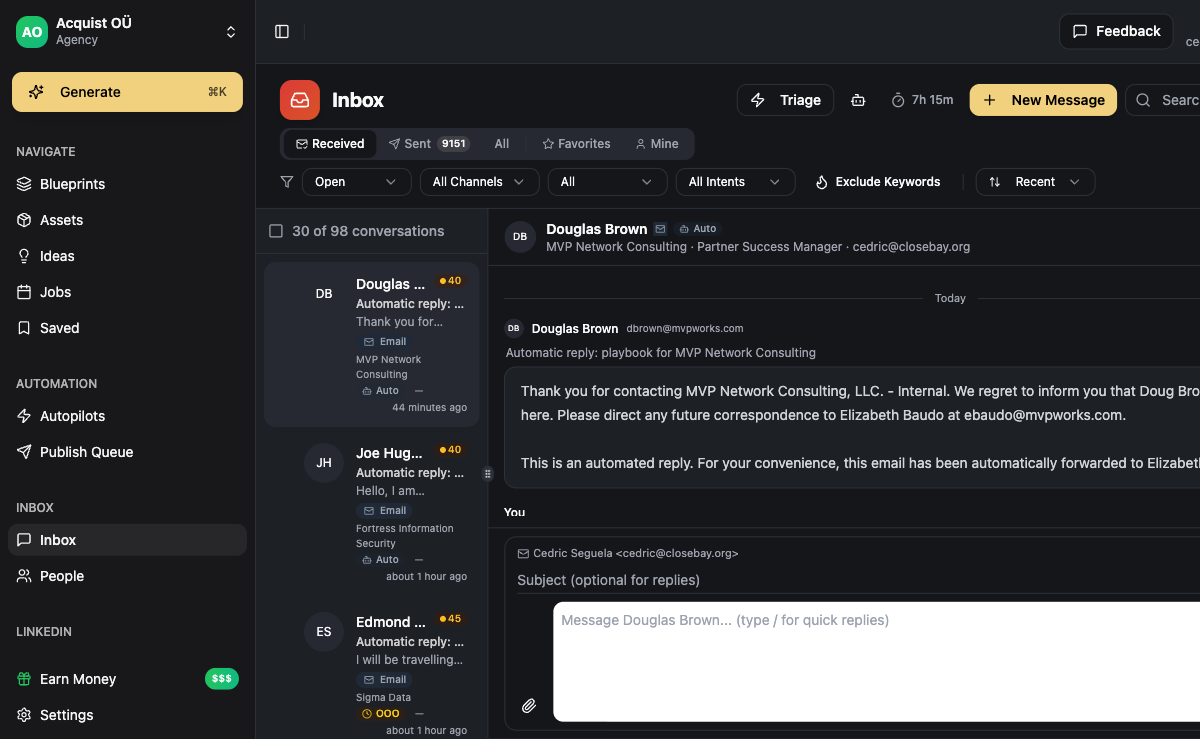
Inbox and reply management. Every reply across every channel routes to one place. Positive replies get handled by you or a trained VA within 60 minutes during business hours. Out-of-office replies, soft passes, and not-now responses route into a follow-up sequence rather than dying in an inbox.
Reporting system. Weekly or biweekly summary sent to every client showing volume, replies, meetings, pipeline. This single habit retains more clients than any other delivery quality improvement. Clients who see consistent reports believe the work is happening even when results have a slow week.
Scaling From 5 to 30 Clients Without Adding a Full Team
The traditional scaling path was: every 5 new clients, hire one junior account manager. That math does not work in 2026. Junior salaries plus payroll overhead consume the margin that AI-powered delivery just unlocked.
The modern scaling path looks different:
- Clients 1 to 5: you do everything. You set up systems, you handle replies, you review every piece of content. This is product development time, not labor.
- Clients 5 to 15: hire one operations VA at 20 to 30 hours per week. They handle reply triage, reporting, and onboarding paperwork. Cost: $1,500 to $3,000 per month. You spend your time on sales, strategy, and exception handling.
- Clients 15 to 30: hire a second specialist VA for content or copy review. Optionally hire a part-time sales appointment setter so you can stop running your own pipeline and focus on closing.
- Clients 30+: hire an account manager for client relationships and consider a sales hire. This is when traditional agency overhead starts making sense again because the revenue base supports it.
The scaling rule: never hire to do something a system could do unattended. Every hire should be exception handling and relationship work, not repetitive production.
White-Label Productization
The agencies that compound past $50K/month MRR almost always cross a threshold where their platform becomes part of their product. The client sees your branded dashboard, your branded reports, your branded login. The underlying tooling is invisible. This is white-labeling, and it changes the conversation in three ways:
- Pricing power. You are no longer reselling someone else's tool. You are delivering your own platform. Premium pricing follows.
- Retention. Clients are inside your environment. Switching costs go up.
- Asset value. A white-labeled book of business sells at a higher multiple than a services-only agency because the buyer is acquiring a platform business, not a labor business.
Building your own platform from scratch is a 12 to 24 month engineering project that most service operators should not take on. White-labeling someone else's infrastructure compresses that to a one-week setup. The tradeoff: pick infrastructure that lets you ship your own brand, your own login, and isolated workspaces per client without per-seat fees that erode the margin you just gained.
Tooling Stack: What to Use, What to Skip
The stack a new agency needs in 2026 is much smaller than the stack a 2020 agency needed. Most of the line items you see in "100 agency tools you need" listicles are obsolete or duplicative. Here is what actually matters.
What you need
- A multi-channel outreach platform. One platform that runs LinkedIn, email, WhatsApp, and optionally Instagram, Telegram, and SMS in coordinated sequences with a unified inbox. ACA's campaign builder does this with workspace isolation for agencies running multiple clients.
- A CRM with pipeline tracking. Built into your outreach platform if possible. Standalone CRMs (HubSpot, Pipedrive) are fine if your delivery platform syncs cleanly, but the friction of two systems compounds at 10+ clients.
- An AI content pipeline (if you sell content). Blueprint-based generation so each client's voice is configured once, then content production runs on a schedule. ACA Blueprints handles this.
- A lead sourcing source. Apify, Clay, or similar. Pay-per-search models beat monthly database subscriptions for most new agencies.
- Email infrastructure. Google Workspace inboxes on secondary domains, with SPF, DKIM, and DMARC configured. Plan on 8 to 12 inboxes for a 5-client lead-gen agency.
- A scheduling tool. Calendly, Cal.com, or similar. Free tier is fine.
What you can skip
- Project management software (Asana, Monday, ClickUp). A shared doc and a weekly call run a 5-client agency cleanly. Add tooling at 15+ clients if pain forces it.
- Marketing automation platforms (Mailchimp, ActiveCampaign). Your outreach platform handles sequences. Marketing automation is a different problem.
- Separate analytics dashboards. Your outreach platform's reporting + a Google Sheet for monthly client summaries is enough until you cross 20 clients.
- Standalone social media schedulers. If your content pipeline publishes, you do not need a separate scheduler.
Common Mistakes That Kill New Agencies
After watching hundreds of operators start agencies, the failure patterns are remarkably consistent. The ones that survive year one usually avoid most of these. The ones that fold by month 9 usually hit three or more.
- Niche switching every 2 months. If you cannot commit to a niche for 12 months, you will never reach the compounding phase where outbound copy is sharp, case studies are relevant, and referrals start flowing.
- Underpricing the first 5 clients. You undercharge to close. They become your lowest-margin clients. They demand the most attention. You burn out at month 4 with $8K MRR that does not pay you a living wage.
- Skipping infrastructure on day 1. Sending cold email from your primary domain, using one LinkedIn account for all clients, running shared sending infrastructure. The first deliverability problem cascades across every client.
- Selling activity, not outcomes. "We do outreach" is a commodity offer. "We deliver 10 qualified meetings per month or you do not pay" is a product.
- No reporting cadence. Clients churn at month 3 not because results are bad but because they do not see the work happening. Weekly reports retain clients through slow weeks.
- Building before selling. 90 days designing a website, a logo, a brand book, a service deck. Zero clients in pipeline. The right order: sell first, deliver second, brand third.
- Hiring too early. Adding a junior account manager at client 3 to "prepare for scale" eats your margin and slows your decision-making.
How ACA Fits Into a New Agency
ACA is the operating system most new agencies need but do not realize they can have. Multi-channel outreach across 6 channels (LinkedIn, email, WhatsApp, Instagram, Telegram, SMS), an AI content pipeline with per-client blueprints, a unified inbox, a built-in CRM, and white-label workspaces with isolated infrastructure per client. The economics are designed around BYOK pricing so your delivery cost stays flat as you add clients, instead of scaling per-seat the way most agency stacks do.
For a new agency: one platform replaces what would otherwise be 5 to 9 separate tools. For a scaling agency: the per-client workspace isolation and white-label capabilities let you sell your own product, not a reseller package. Either way, the same infrastructure carries you from client 1 to client 50.
Frequently Asked Questions
How much money do I need to start an agency in 2026?
Less than you think. The realistic floor is $500 to $1,500 for the first month of operations: secondary domains, mailbox subscriptions, lead sourcing credits, and your outreach platform. Most operators reach cash-flow positive within 60 days if they execute outbound consistently. The bigger cost is time. Expect 90 days of focused execution before the agency pays itself.
How long does it take to land the first client?
30 to 60 days is normal if you commit to outbound from day one and have a clear niche. Operators who spend the first 60 days on branding, website, and "getting ready" usually take 4 to 6 months to land their first paying client because they avoided the actual work of selling. The fastest path is to start outreach in week one with a workable offer and iterate as you learn what resonates.
Do I need to incorporate before I take my first client?
You can take your first 1 to 3 clients as a sole proprietor in most jurisdictions, then incorporate (LLC in the US, Ltd in the UK, equivalent elsewhere) once you have revenue to support it. Some clients will require an entity to sign a contract, especially in larger B2B segments. Setting up an LLC costs $100 to $500 in most US states and takes a few hours. Do not let incorporation block you from selling for 6 weeks.
Should I hire a team early or stay solo as long as possible?
Stay solo until you cross 5 clients minimum. Solo operations force you to systemize delivery rather than throwing labor at problems. Most successful AI-powered agencies stay at 1 to 2 people until 15+ clients, then scale headcount slowly and selectively. The temptation to hire at 3 clients almost always backfires because new hires need management, and management is exactly what you do not have time for at that stage.
What if I have no sales experience?
Most successful agency operators did not start with formal sales experience. The skill that matters more than "sales" is genuine curiosity about your prospects' problems combined with willingness to make 30 to 50 outreach touches per day for 90 days. Outbound is a learned skill. The first 200 outreach messages teach you what works. The next 1,000 sharpen it. You learn by doing, not by reading another book.
Can I run an agency part-time while keeping a day job?
For the first 60 to 90 days, yes. Most operators start an agency on nights and weekends, land 2 to 3 clients, and then leave their job once the agency revenue covers their living costs. The risky version is trying to run 10+ clients on nights and weekends, which leads to delivery quality collapse. Set a transition trigger (for example, $8K MRR for 2 consecutive months) and commit to going full time when you hit it.
What is the best agency model for someone with no technical background?
Lead generation agency or content agency. Both rely on operating tools rather than building them. Modern platforms abstract the technical infrastructure (deliverability, content generation, channel APIs) so the operator's job is to configure systems and manage relationships. The technical depth you need is enough to know when something is broken, not enough to write code.
How do I know if my niche is too narrow?
If you can name 500 prospects who fit your ICP, the niche is wide enough to support a real agency. If you can only name 50, it is probably too narrow and you will hit pipeline limits within 6 months. The sweet spot is a niche where there are at least 2,000 to 5,000 fitting prospects globally, which is small enough to dominate and large enough to feed years of outbound.