Starting an SDR agency in 2026 is not about hiring offshore callers and emailers anymore. The model that works now is selling sales-as-a-service powered by AI SDRs, where one operator runs the equivalent output of a 10-person SDR team across LinkedIn, email, WhatsApp, and phone. You charge per meeting booked or a hybrid retainer, deliver qualified pipeline within 30 days, and keep margins above 70% because the dialer, sequencer, and CRM all run on top of one consolidated stack.
Short answer: To start an SDR agency in 2026, pick one niche (B2B SaaS, recruiting, financial services, or agencies), price per meeting booked at $250 to $500 each or a $3K to $6K monthly retainer, build an AI SDR stack with a multi-channel sequencer plus a unified CRM with isolated client routing, and sign your first three clients before hiring anyone. The platform does the work. You manage the relationships.
What an SDR Agency Actually Sells in 2026
An SDR agency (Sales Development Representative agency) sells outbound pipeline as a service. The client outsources the entire top-of-funnel motion: prospecting, multi-channel outreach, qualification, and meeting booking. They get sales-qualified meetings dropped into their calendar. You get a monthly retainer or a per-meeting fee.
The old model was labor-arbitrage. Hire SDRs in the Philippines or Latin America at $1,500 per month, charge the client $5,000, pocket the spread. That model still exists but is collapsing for two reasons. First, clients can hire the same offshore talent directly on Upwork now. Second, AI SDRs outperform human SDRs on volume and consistency in the prospecting and first-touch phase, which is most of the job.
The 2026 model is AI-native. You build a system where AI handles the volume work (research, sequencing, first replies, meeting booking) and you handle the strategy work (offer design, copy, client management, escalations). One operator can run 8 to 15 clients before needing a second person.
Why SDR Agencies Are a Good Bet Right Now
Three forces converged in 2024 to 2025 that make SDR-as-a-service the right play for new agencies in 2026.
In-house SDR economics broke. A fully-loaded SDR in the US costs $80K to $120K per year by the time you add base salary, OTE, benefits, tools, and management overhead. They book 8 to 12 meetings per month if they are good. That is a cost per meeting north of $800. A well-run SDR agency delivers the same meetings at $250 to $400 each, so the buying decision is obvious.
Multi-channel became table stakes. Email-only outbound stopped working at scale in 2024. Reply rates on cold email dropped as inbox filtering tightened and prospects got desensitized. The agencies winning now run LinkedIn plus email plus WhatsApp plus sometimes phone in coordinated sequences. In-house teams cannot stitch this together without buying 5 separate tools and a glue layer. You can.
AI closed the personalization gap. Mass-personalized outreach used to require either a researcher per 200 leads or generic templates that converted badly. AI SDR tooling now generates per-prospect openers, value props, and follow-ups at the same quality as a manual researcher, at 1/100th the cost. The margin compression that hit traditional SDR agencies is your tailwind.
Pricing Models: Retainer, Per Meeting, or Hybrid
There are three serious pricing models for an SDR agency. Pick one and stick with it across your first 10 clients. Mixing models early creates pricing chaos.
Flat monthly retainer
You charge $3,000 to $6,000 per month for a defined deliverable: a number of contacts reached, sequences sent, or a campaign managed. The client takes the risk on meeting volume. You take the risk on input quality (list, copy, offer).
This works when you control the strategy and the client trusts you. It does not work when the client has a weak offer or unclear ICP, because they will blame you when meetings do not book even though the inputs were broken.
Pay per meeting (PPM)
You charge $250 to $500 per qualified meeting that shows up. The client takes zero volume risk. You take all of it. This sounds risky but is actually the best model for a confident operator because the math is simple: if your blended cost per meeting (tools plus your time) is under $100, every meeting is pure margin.
The trap with PPM is qualification disputes. Define "qualified" upfront in writing. Standard SQL criteria: prospect is the decision-maker or budget-holder, fits the ICP on company size and industry, has been pre-qualified for intent, and actually attends the meeting. No-shows do not count unless you charge for booked-but-no-show separately.
Hybrid: small retainer plus per meeting
$1,500 to $2,000 base retainer plus $150 to $250 per meeting. This is what most established SDR agencies converge on. The retainer covers your fixed costs (tools, list-building, setup) and lets you say no to clients who want unlimited revisions. The per-meeting fee aligns incentives.
Use flat retainer when: you are selling to clients with strong existing offers who want predictable monthly spend and you have confidence in your delivery.
Use pay per meeting when: you are new, need to overcome objections, and want maximum margin per deal. Best for niches where lifetime value is high enough that clients can pay $400+ per meeting.
Use hybrid when: you want stability without being on the hook for revenue alone. This is the model most agencies should land on by client number 5.
The AI SDR Stack You Actually Need
Stop reading agency Twitter threads listing 14 tools. You need 4 functional components and they should ideally be in one platform. If they are not, you are spending 20 hours a week on integration glue instead of running campaigns.
- Lead sourcing and enrichment. Where prospects come from. Apollo, Apify B2B Lead Finder, LinkedIn Sales Navigator, or scraped from public sources. You need 1,000 to 5,000 fresh contacts per client per month.
- Multi-channel sequencer. The engine that executes outreach steps in order across LinkedIn, email, WhatsApp, and sometimes Instagram or SMS. Must handle branching logic (if replied on LinkedIn, stop email sequence) and pause-on-reply.
- Unified inbox with AI replies. One place where all replies from all channels land. AI handles first-pass responses (booking calls, answering FAQs, qualifying) and escalates anything ambiguous to you.
- CRM with isolated client routing. A pipeline view per client where you can see meetings booked, conversations in flight, and which leads are at which stage. "Isolated client routing" means each client's data is fully separated. Their leads, conversations, and sender accounts cannot leak into another client's workspace.
Optional but high-value additions: a dialer if you offer cold calling, a meeting-booking layer with confirmation and reminder logic, and an AI content engine for warm-up content on the sender's LinkedIn profile so the cold outreach lands on a real-looking profile instead of a ghost account.
How Isolated Client Routing Actually Works
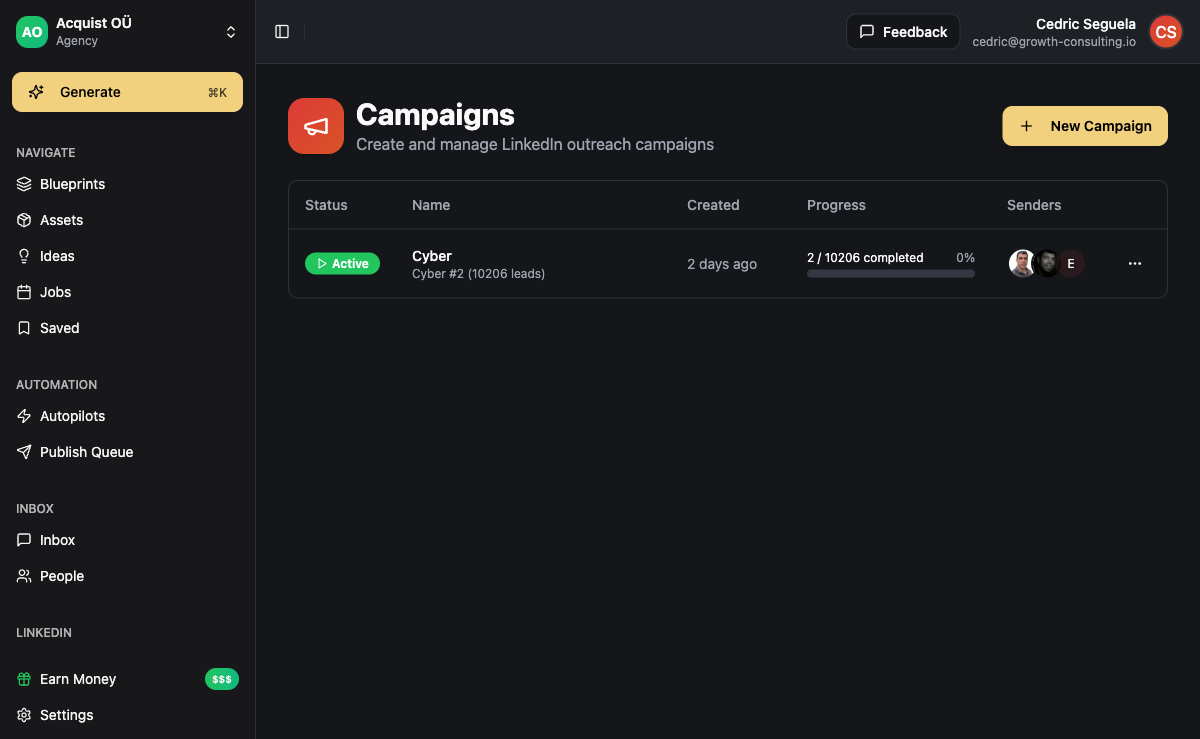
This is the operational detail that decides whether your agency scales past 3 clients or implodes at client 5. When you run outbound for multiple clients, every client needs their own sender accounts, their own lead lists, their own conversation thread, their own CRM pipeline, and their own performance dashboard. None of those can mix.
The wrong way to do this is one shared workspace with tags for which client each lead belongs to. This breaks the first time you accidentally email Client A's prospect with Client B's pitch. It also fails compliance review the moment a serious client asks how you handle their data.
The right way is workspace isolation per client. In ACA's AI SDR setup, every client gets a dedicated workspace with their own sender pool (email accounts on their domain, LinkedIn accounts belonging to their team or your operators), their own lead database, their own CRM pipeline, and their own inbox. You as the agency operator see all workspaces from a top-level admin view, but the data never crosses.
Client routing also matters for replies. When a prospect replies to a sequence, the AI needs to know which client's playbook to use for the response. "Yes, send me more info" means something different if you are selling AI recruiting tools to staffing agencies versus selling fractional CFO services to startups. Per-workspace AI configuration solves this.
Operator-to-client ratio benchmark: a well-tooled SDR agency operator can run 8 to 15 clients before needing a second person. The bottleneck is usually inbox triage time (replies that need a human eye) and weekly client reporting calls, not campaign setup. Source: ACA agency operator observations and public benchmarks from SDR agencies operating on multi-channel AI stacks.
How to Land Your First Three Clients
The agencies that fail at this stage are the ones who try to sign 10 clients in 30 days using cold outbound to other agencies. Your first three clients should come from your existing network or from a tightly-defined niche where you can name 200 target companies by hand.
Step 1: Pick a vertical. Not "B2B SaaS," that is too broad. Pick something like "HR tech companies between $5M and $30M ARR who sell to mid-market HR leaders." The narrower the niche, the easier the pitch, the higher the price you can charge, and the more your case studies compound.
Step 2: Build the offer on paper. One page. What you deliver, how it is measured, what it costs, what the client is responsible for, what you are responsible for. If you cannot write this in one page, you do not have an offer yet.
Step 3: Pitch your own network first. Anyone you know who runs a company in that vertical, or who can introduce you to one, gets the offer. Free first month or heavily discounted setup in exchange for a case study at month 2. The case study is worth more than the discount you give up.
Step 4: Use your own service to land more clients. Build a campaign targeting your ICP, run it against 1,000 prospects, book demos. If your own SDR service cannot fill your own pipeline, you do not have a service to sell yet. This is the test.
Delivery Workflow for One Client
Here is what month 1 looks like for a new client, in order:
- Week 1: Onboarding and offer alignment. Kickoff call to confirm ICP, value prop, qualification criteria, and what counts as a booked meeting. Get access to their domain for email sender setup, or set up new domains and warm them up if they want to keep their primary clean.
- Week 1-2: Domain warm-up and list building. New sending domains need 2 weeks of warm-up before they can send cold volume. Use the time to build the initial 2,000 to 5,000 lead list and write the sequence copy.
- Week 2-3: Soft launch. Run the sequence on 500 leads at low volume. Watch reply quality, inbox placement, and qualification rate. Adjust copy and targeting before scaling.
- Week 3-4: Full launch. Scale to the planned weekly volume. First meetings book in week 4. Send the client a weekly Loom update with numbers and any signal patterns you see.
- Month 2+: Optimization loop. Test new openers, swap channels in the sequence, refresh the lead source, replace burnt-out angles. Monthly call with the client to review the pipeline and adjust direction.
Per-client time investment after setup: 2 to 5 hours per week including reporting calls. That is what makes the 8-to-15 clients per operator ratio possible.
Common Mistakes That Kill SDR Agencies
- Taking any client who will pay. A client with a broken offer, weak product, or unclear ICP cannot be saved by outbound. You will burn 90 days, miss their meeting targets, and lose them anyway. Qualify clients harder than they qualify you.
- Promising results in week 1. Domain warm-up takes 2 weeks minimum. First meetings book in week 3 to 4. Promising faster is how you set yourself up to lose the client at day 21 when the pipeline is empty.
- Stacking 9 tools instead of consolidating. Apollo plus Smartlead plus Lemlist plus Salesloft plus Hubspot plus Calendly plus Notion plus Zapier plus a custom reporting dashboard. Every tool is another integration breakpoint and another $50 to $200 per client per month. Consolidate to a single platform that does outreach plus inbox plus CRM plus routing under one workspace.
- No client routing isolation. One shared workspace across clients. Works until it does not. The first time you cross the streams is also the last time that client renews.
- Pricing too cheap. $1,500 retainers attract clients who micromanage and complain. $4,000 to $6,000 retainers attract clients who treat you like a partner. The work is the same. The clients are not.
Scaling Past Your First Ten Clients
Around client 8 to 10, the bottleneck stops being your selling time and becomes your operations time. This is where most solo SDR agencies stall and never grow past $50K per month.
The unlock is hiring one operations person, not a salesperson. Ops handles list building, sequence loading, daily inbox triage of obvious replies, and weekly reporting. You stay on strategy, offer design, client calls, and high-value reply handling. With a $4K to $6K per month ops hire, you can run 20 to 30 clients instead of 10.
Beyond 30 clients you need a second strategist and a second ops person, plus an account manager for client retention. At that point you are running a real business with hiring, management, and process documentation. That is a different problem set than the one you are solving on day one.
For most readers, the goal is not 100 clients. The goal is 12 to 20 clients at $4K to $6K each, which is a $50K to $120K per month agency that one operator plus one ops person can run. That is a 70% margin business with no inventory, no office, and no fundraising.
Frequently Asked Questions
How much money do you need to start an SDR agency?
Under $1,000 if you are smart about it. The big costs are platform ($50 to $200 per month for the outreach and CRM stack), sending domains ($15 per year each, you need 3 to 5 for your first client), domain warm-up service or built-in warm-up via your platform, and a lead source ($50 to $200 per month for Apollo or similar). You do not need a website, an LLC, or business cards on day one. You need a working pitch and three conversations.
Do I need sales experience to start an SDR agency?
You need to have done outbound at least once before, either in-house or as a freelancer. Trying to sell sales-as-a-service when you have never booked a meeting from cold outreach yourself is selling a service you cannot deliver. Spend 60 days running outbound for your own project first. Use the case study you generate as your sales asset.
How long does it take to make money with an SDR agency?
First client signed in 30 to 60 days if you have an existing network. First $10K month at client 3 to 4 if you price at $3K to $4K per retainer. First $30K month at client 8 to 10. The exponential curve hits once you have 5 case studies and can sign clients off referrals and inbound instead of cold outbound. That is usually month 6 to 9.
Can one person really run 10+ SDR clients alone?
Yes, but only with the right stack. Per-client time after setup should be 2 to 5 hours per week including the client call. 10 clients at 3 hours each is 30 hours per week, which is a full work-week with no buffer. To go past 10 you either consolidate your tooling more, hire ops, or both. The constraint is rarely campaign execution. It is inbox triage and reporting.
What is the difference between an SDR agency and a lead generation agency?
A lead generation agency delivers contact lists or top-of-funnel signal (downloads, opt-ins, content engagement). An SDR agency delivers booked meetings with qualified decision-makers. The price point and the deliverable are different. Lead gen is $1K to $3K per month for a list and a campaign. SDR-as-a-service is $3K to $8K per month or per-meeting pricing for actual sales-ready meetings. The SDR model is harder to deliver but has 3 to 5x the lifetime value per client because you are tied to revenue, not lists.
What niches work best for SDR agencies in 2026?
B2B SaaS companies between $1M and $20M ARR who need pipeline but cannot afford a senior SDR team. Recruiting firms who need candidate or client outbound at scale. Financial and professional services (fractional CFOs, M&A advisors, boutique consultancies) where one closed deal is worth $50K+ and they can pay $500 per meeting comfortably. Other agencies who want to white-label outbound but not build the operational stack. Pick one and own it for 12 months before adding a second vertical.
Should I use AI SDR tools or hire human SDRs?
Use AI for volume work (prospecting, sequencing, first-touch replies, meeting booking) and human attention for strategy (offer, copy, escalations, client management). The 100% human SDR model is too expensive to compete with in 2026. The 100% AI model loses on judgment calls and complex replies. The winning model is AI-first with one human operator per 10 clients.