A white-label AI agency platform is software you resell to clients under your own brand, with your own pricing, your own logo, and your own client workspaces. In 2026, the bar is higher than slapping a logo on a login screen. You need real multi-tenant isolation, branding controls down to the domain, separated billing and credentials, and a unified surface that covers both outreach and content. This post walks through what to demand and how to actually build margin on top.
Short answer: A real white-label AI agency platform gives you isolated client workspaces, your own brand on the UI and domain, separated billing and API keys per client, and a unified product surface (outreach plus content plus CRM) so you sell one branded subscription instead of reselling five tools. Anything less is reseller cosplay - your clients see the underlying vendor within a week and start questioning your pricing.
What "White-Label AI Agency Platform" Actually Means in 2026
The term "white-label" gets stretched until it means nothing. A landing page that swaps your logo for theirs is not white-label. A reseller dashboard with a custom subdomain is not white-label either if your clients still see the underlying vendor's name in confirmation emails, billing receipts, or the URL bar on Tuesday afternoons.
White-label in 2026 means three things at minimum:
- Brand replacement is total. Your logo, your colors, your domain, your sender name on transactional emails, your favicon on the browser tab. A client who screen-shares with their team should never see a vendor's name leaking through.
- Tenancy is isolated. Each client gets a workspace with its own data, its own sending accounts, its own pipelines, and no path to see another client's work. A bug in your stack should never expose Client A's leads to Client B.
- Margins are yours to set. You bring the API keys, you set the pricing, you keep the spread between cost and what you charge. Per-seat reseller pricing that scales with your client's headcount does not qualify.
The reason this matters: agencies in 2026 are not competing with other agencies. They are competing with their clients' ability to spin up the same tools directly in 30 minutes. If your value is "I bought Smartlead and put my logo on it," your client will figure that out and cut you out. If your value is a unified branded product that does what five separate tools would do, you have a moat.
The Core Components Every Real White-Label Platform Needs
Here is what to check for before you commit to any white-label AI platform. Skip any of these and you are renting margin you do not own.
Multi-tenant client workspaces
Each client lives in their own workspace with isolated data, users, sending accounts, sequences, and reporting. You as the agency operator can move between workspaces from a single login. Your clients see only their workspace. There is no "global" view that leaks one client's metrics into another's dashboard.
The correctness test: log in as Client A. Try every URL you can think of to access Client B's data. If anything works, the platform is not actually multi-tenant - it is single-tenant with permission flags, which fails the first time a sales rep with stale credentials does something they should not.
Branding and domain controls
Branding goes beyond logos. The platform should let you control:
- Custom domain (app.youragency.com instead of clients.somevendor.com)
- Logo, colors, and typography across the entire UI
- Transactional email sender name and domain (welcome emails, password resets, notifications)
- Documentation and help links that point to your support, not the vendor's
- Favicon and browser tab title
If any of these still show the underlying vendor's brand, your white-label is incomplete and your clients will eventually notice.
Billing isolation and margin control
You charge the client. The platform vendor does not. Your client's credit card never touches the underlying vendor's billing system. This is not just a branding issue - it is a margin issue. If the vendor charges per seat or per client and passes that cost through to your client directly, you have no spread to capture.
The model that actually works in 2026 is BYOK (Bring Your Own Key). You connect your own API keys for the AI providers (OpenAI, Anthropic) and pay actual usage cost. You bill your client whatever the market supports. The delta is your margin.
Margin math for a typical agency setup: at retail pricing for a single client running multi-channel outreach plus content generation, you would pay roughly $1,000-$1,300/month across separate tools (outreach platform, content tool, CRM, inbox manager, scheduler). A white-label platform with BYOK consolidates that into $50-80/month per client in delivery cost. The spread between delivery cost and what clients pay for the outcome is where agency margin lives. Source: ACA internal delivery cost benchmarks.
API key and credential isolation
Each client's sending accounts, AI keys, integrations, and credentials live in their workspace. If you offboard Client A, you revoke their workspace and their credentials go with it. If Client B has a security issue, it does not touch Client A.
This sounds obvious. It is not - most "reseller" tools store credentials at the agency level and just attribute them to clients, which means an offboarded client's data can linger in your account forever and a credential leak is a multi-client incident, not a single-client one.
Why Most "White-Label" Tools Are Not Actually White-Label
If you go shopping for white-label AI tools in 2026, most of what you find falls into one of these categories:
- Logo-swap reseller programs. You get to put your logo on the login screen. The product, the URL, the support emails, the documentation, and half the in-app copy still reference the underlying vendor. Not white-label.
- Per-seat resold SaaS. The vendor charges you per seat, you mark it up and resell it. Your margin is capped at whatever the vendor leaves you, and your client's bill scales linearly with their team size. Reseller, not white-label.
- Single-feature white-label. One specific feature is brandable (a landing page builder, a chatbot widget), but the operator dashboard, billing, and admin interface are still vendor-branded. Partial white-label, which means partial margin.
- Enterprise-only white-label. The vendor offers genuine white-label, but only on $5,000+/month plans. Useful if you have already scaled past 50 clients. Useless if you are trying to start.
The category that actually works for agencies starting or scaling in 2026 is platforms built white-label-first - where multi-tenant isolation, branding, and BYOK billing are core to the product, not premium add-ons.
How ACA Delivers the Unified Outreach + Content White-Label Layer
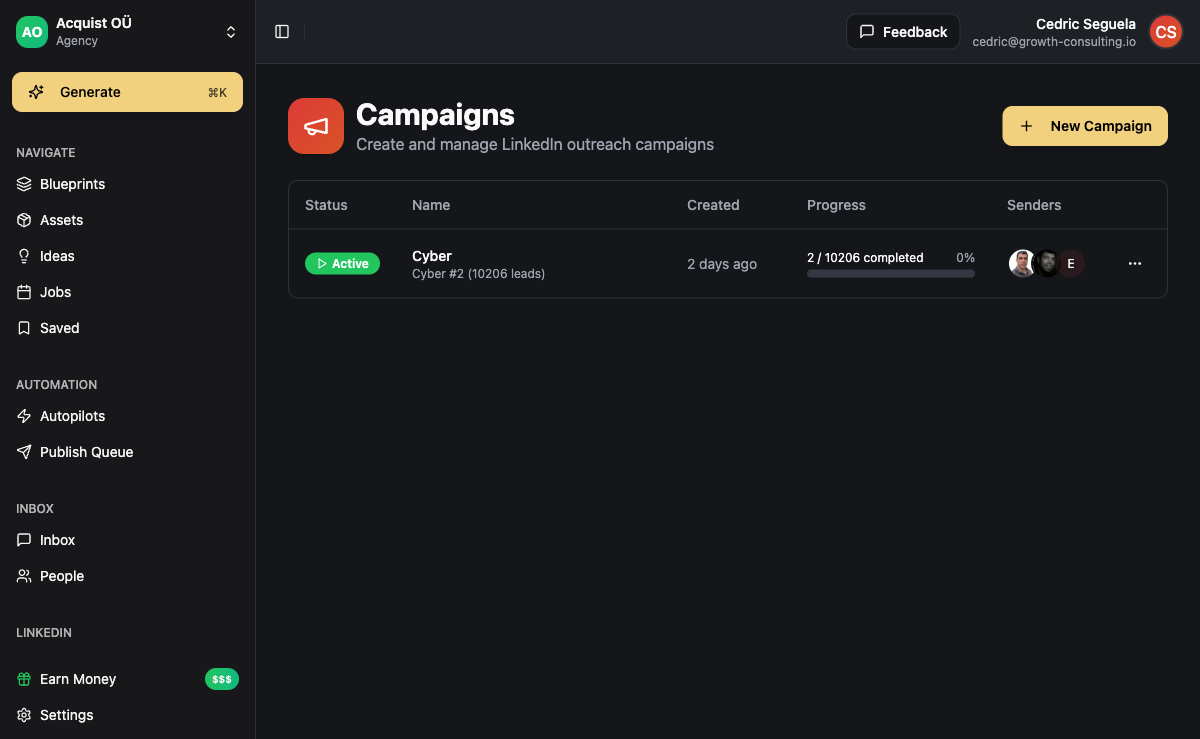
ACA was designed for agencies. Multi-tenant client workspaces, full branding, BYOK API keys, and a unified product surface across outreach and content are core features, not enterprise upcharges. Here is what that looks like in practice.
Isolated client workspaces: every client gets their own workspace with separate sending accounts (LinkedIn, email, WhatsApp, Instagram, Telegram, SMS), separate sequences, separate inbox, separate CRM pipeline, and separate content blueprints. You as the agency operator move between workspaces from a single account.
Full branding: custom domain, your logo, your colors, your transactional emails. Clients log in to your branded product, not ours.
BYOK economics: you bring your own AI API keys (OpenAI, Anthropic, others). You pay actual usage cost - typically $50-80/month per client across delivery. You charge your clients whatever the market supports. The spread is yours.
Unified surface: outreach across 6 channels, AI content generation (posts, carousels, newsletters, videos), unified inbox, built-in CRM with ICP scoring, and lead magnet workflows - all in one platform. This is the part that creates real lock-in for your agency: your clients are not buying five tools with your logo on the login screen, they are buying one branded product that genuinely does what five tools would do.
For a deeper look at the agency model this enables, see the ACA for AI Agencies page.
How to Price Your White-Labeled AI Services
Pricing the wrapped product is where most agencies leave money on the table. Three pricing models that work in 2026:
- Flat monthly retainer. $2,500-$5,000/month per client for a full done-for-you service: outreach setup, content production, inbox management, lead routing. Simple, predictable, easy to sell. Best for agencies starting out.
- Performance-tiered retainer. Base retainer ($1,500-$2,500/month) plus performance bonus tied to booked meetings or qualified leads. Aligns incentives. Best for agencies with a track record they can underwrite against.
- Branded SaaS subscription. Sell the platform as a self-service product under your brand. Lower price point ($300-$800/month per client) but scales without proportional service delivery cost. Best for agencies that have productized their workflow.
Use the flat retainer model when: you are starting out, your service is high-touch, and you want predictable revenue without performance risk.
Use the performance-tiered model when: you have data showing your service consistently produces results and you want to charge premium prices justified by upside.
Use the branded SaaS model when: your delivery has been productized enough that adding a client does not add proportional service hours, and you want to scale beyond what high-touch retainers allow.
Common Pitfalls When Reselling AI as Your Own Brand
Things that kill agency margin and trust, in our experience:
- Picking a platform that leaks the vendor's brand. Confirmation emails from a name your client has never heard of. Support docs that mention a different product. A subdomain that includes the vendor's name. Any of these collapse the illusion and your pricing comes under pressure within weeks.
- Charging per seat when your platform charges flat. If the underlying platform is BYOK and flat-cost, do not pass per-seat pricing through to your client. You will lose deals to competitors who price the outcome instead of the seat count.
- Selling "AI" instead of selling outcomes. Clients do not buy AI. They buy leads, meetings, content production, and time back. Frame the offer around the outcome, not the technology under the hood.
- Skipping client workspace isolation in the demo. When you demo the product, log in to a real isolated workspace. Do not show prospects a screenshot from another client's account with the data blurred out. They will notice and ask uncomfortable questions about data isolation.
- Promising features the underlying platform does not have. If your contract says "AI-generated video content" and the platform does not generate video, you are now paying out of pocket to fill the gap or losing the client. Audit your contracts against actual platform capability.
Frequently Asked Questions
What is the difference between a white-label AI platform and a reseller program?
A white-label platform gives you full brand control, isolated client workspaces, and your own billing. A reseller program just lets you mark up someone else's product - your clients usually still see the underlying vendor somewhere, and your margin is capped at whatever the vendor leaves you. Reseller programs are about distribution; white-label is about owning the customer relationship.
Do I need to be technical to run a white-label AI agency?
No. The whole point of a white-label platform is that the technical work (multi-tenancy, branding, integrations, sending infrastructure) is done for you. You need to understand how to sell outcomes, configure the platform for each client's ICP and offer, and manage the relationship. Coding is not required.
How much margin can I actually capture with a white-label AI platform?
It depends on your pricing model and delivery cost, but the spread is typically wide. With BYOK economics, delivery cost runs around $50-80/month per client. Agencies charging $2,500-$5,000/month retainers for full-service delivery capture most of that as gross margin before service hours. Specific numbers depend on your offer, your niche, and how productized your delivery is.
What happens to my clients if the underlying platform shuts down?
This is a real risk with any reseller or white-label model. Mitigation: pick a platform with exportable data (so you can move clients to a different stack if needed), keep client relationships and contracts in your name (not the vendor's), and avoid platforms that lock contact data into proprietary formats you cannot retrieve.
Can I white-label individual features instead of the whole platform?
Some platforms allow this - for example, white-labeling only a chatbot widget or a landing page builder while the operator dashboard stays vendor-branded. This works if your service is a single narrow feature. For a full agency offering covering outreach plus content plus CRM, you need full-platform white-label or your clients will eventually see the seams.
How do I demo a white-label platform without showing other clients' data?
Set up a demo workspace inside your white-label tenant with sample data that mimics a realistic client setup. Use this for all sales calls. Never demo from a real client workspace - it raises legitimate data privacy concerns and can violate your client contracts depending on what is visible.
Is white-label AI legal? Do I need to disclose the underlying vendor?
White-label agreements are standard commercial arrangements and legal in essentially every jurisdiction. Disclosure requirements depend on your contracts with clients and any specific regulations in your industry. Most agencies do not disclose the underlying vendor by default - that is the entire point of white-label. Check your platform's reseller terms for any specific disclosure clauses before signing.