AI brand voice training is the process of giving an AI model enough structured input that it produces content indistinguishable from what your team would write by hand. The three things that actually move the needle are real writing samples, explicit do and don't rules, and a defined character profile. Get those right and you stop editing every output. This guide shows you how to build one in ACA, how it compares to Jasper Brand Voice and Writer Styles, and the mistakes that kill voice consistency.
Short answer: train an AI on your brand voice by feeding it 5 to 10 real writing samples, a short list of do's and don'ts, and a character profile that describes who the brand sounds like as a person. Without those three inputs, the model defaults to generic marketing tone no matter how detailed your instructions are.
What Is an AI Brand Voice?
AI brand voice is a structured prompt or fine-tuning configuration that conditions a large language model to produce content matching the tone, vocabulary, sentence structure, and personality of a specific brand. It typically combines writing samples (the examples), behavioral rules (the do's and don'ts), and a character profile (the who) so the model has both pattern data and explicit constraints. The result is content that needs minimal editing instead of full rewrites.
Most people approach this wrong. They write a 200-word brand voice description that says things like "professional but approachable" and "confident yet humble" and then wonder why every output sounds like a LinkedIn thought leader on autopilot. Adjectives don't train models. Patterns do.
The model needs to see what your brand actually writes, what it never writes, and what kind of person would write it. Those three layers (sample, rule, character) work together. Skip one and the voice collapses back to generic.
The Three Inputs That Shape a Working Voice
Writing samples (the examples)
Start with 5 to 10 pieces of real writing from your brand. Not the polished marketing pages, the actual content that sounds like you. Newsletter intros, founder LinkedIn posts, product launch announcements, customer responses. The point is to give the model pattern data: how long are your sentences, what rhythm do you use, what kinds of openings, what kinds of closers.
If you use 5 samples that all sound different, you have taught the model nothing. If you use 5 samples that share the same cadence, the same opinion-forward openings, the same kinds of metaphors, you have given it something to copy. Quality and consistency of samples matter more than quantity.
Do's and don'ts (the rules)
Samples teach pattern. Rules prevent failure modes. A short, explicit list works better than a long, philosophical one.
Useful rules look like:
- Never use the words "revolutionary", "game-changing", "leverage", or "synergy"
- Always use second person ("you") instead of third person ("companies", "businesses")
- Open with a problem statement, never a dictionary-style definition
- Use contractions ("don't", "you're", "we'll") and never write them out
- One idea per paragraph, two to four sentences maximum
Bad rules look like "be confident but not arrogant" or "sound human". The model cannot act on that. Specific lexical and structural rules survive every prompt and produce predictable output.
Character profile (the who)
This is the input most brand voice systems skip and it is the one that creates the biggest jump in output quality. Describe the brand as if it were a person. What is their background, what do they care about, what do they refuse to do, what is their sense of humor.
"The brand sounds like a 38-year-old founder who has built and sold one company, runs the second one with 12 people, and reads economics and military history for fun. They do not believe in growth hacks, they explain trade-offs honestly, and they assume the reader is smart and busy."
That paragraph carries more signal than 500 words of tone guidelines because the model can simulate a person far better than it can simulate an abstract style description.
In our experience: brands that combine all three inputs (5 to 10 samples, 8 to 12 explicit rules, and a character profile under 200 words) typically need 10 to 20 percent editing on AI output, compared to the 60 to 80 percent editing required when using a generic prompt or a description-only voice configuration. Source: aggregated from ACA agency workspaces running content pipelines at scale.
How to Build Your Brand Voice in ACA
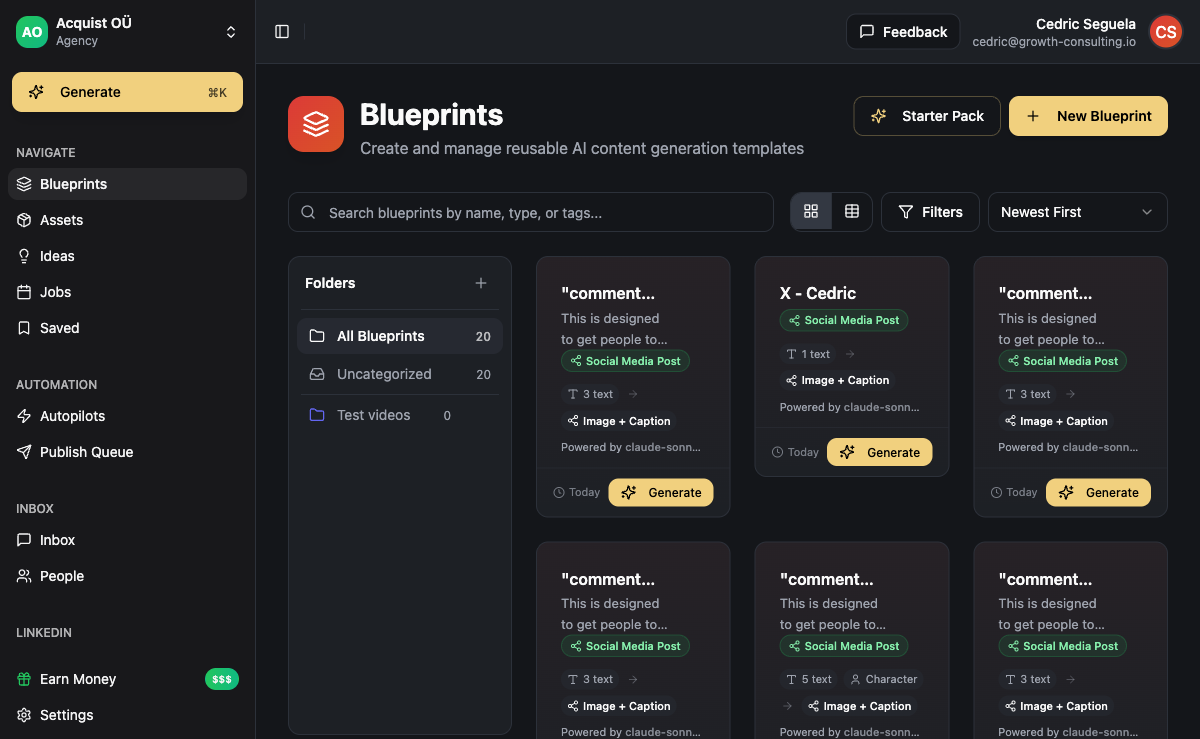
ACA's brand voice system is built around exactly the three inputs above. You configure it once per brand and every content generation routine (posts, carousels, newsletters, outreach personalization) uses the same voice automatically.
The setup flow:
- Create a brand profile. In the workspace, you create a new brand with name, niche, and audience. Each brand gets its own voice configuration. For agencies running multiple clients, each client lives in an isolated brand profile with its own voice.
- Upload writing samples. Paste 5 to 10 pieces of real writing into the samples field. ACA parses them and uses them as in-context examples for every generation. The samples can be different formats (LinkedIn posts, newsletter intros, sales pages) since the model extracts cross-format patterns.
- Define do's and don'ts. A structured field where you list explicit lexical rules, structural rules, and topic boundaries. The interface separates "always" rules from "never" rules so the model treats them with appropriate weight.
- Write the character profile. A free-form field for the persona description. ACA includes prompt examples for founders, agencies, B2B SaaS brands, coaches, and ecommerce stores to make this faster.
- Test and iterate. Generate three sample posts and read them. If something sounds off, add a rule. If a turn of phrase keeps appearing that you hate, add it to the never list. Voice configuration is a 30-minute setup followed by a 10-minute polish after the first batch of outputs.
Once the voice is set, every content pipeline in the brand uses it. Your LinkedIn post blueprint, your newsletter automation, your carousel generator, your outreach personalization, all of them inherit the same voice without needing to be configured separately. This is the part most platforms get wrong: voice should live at the brand level, not the prompt level.
ACA vs Jasper Brand Voice vs Writer Styles
Brand voice is a headline feature of three platforms in particular: ACA, Jasper, and Writer. They take different approaches.
| Capability | ACA | Jasper Brand Voice | Writer Styles |
|---|---|---|---|
| Writing samples input | Yes, 5 to 10 samples | Yes, URL or paste | Yes, via document analysis |
| Explicit do/don't rules | Yes, separate fields | Limited style guide | Yes, full style guide engine |
| Character profile input | Yes, dedicated field | Persona is a separate feature | Not a primary input |
| Where the voice applies | All content and outreach in the platform | Jasper content only | Writer apps and integrations |
| White-label for agencies | Yes, included | Enterprise only | Enterprise only |
| Pricing model | BYOK, flat platform fee | Per-seat subscription | Per-seat enterprise |
| Best for | Agencies and founders running content plus outreach | Content marketing teams | Enterprise content governance |
Jasper Brand Voice is strong on sample analysis. You can point it at a URL or paste content and it extracts a voice profile automatically. The weakness is that Jasper's voice only applies inside Jasper's content tools. It does not extend to outreach, sales messaging, or any workflow outside the platform. For teams that only need marketing content, it works well. For anyone doing outreach or multi-channel work, you would end up configuring voice in two or three different tools.
Writer Styles takes an enterprise governance angle. It is built for large organizations that need to enforce a style guide across hundreds of users, with terminology rules, compliance flags, and editorial controls. Powerful, but heavy. Solo founders and small agencies do not need that infrastructure and will not justify the per-seat enterprise pricing.
Use Jasper Brand Voice when: your team only does content marketing inside Jasper, you have an existing content library to extract voice from, and you do not need agency white-label.
Use Writer Styles when: you are a large enterprise with formal editorial governance, multiple writers, and compliance requirements around terminology and brand consistency.
Use ACA when: you need brand voice to apply across content AND outreach, you run multiple brands (agency model), or you want flat pricing instead of per-seat fees that scale with team size.
The Most Common Voice Training Mistakes
Brand voice configurations fail in predictable ways. Here are the mistakes worth avoiding.
Using marketing copy as samples. Your landing page is the worst possible voice input. It has been edited 40 times by a committee. It sounds like every other landing page. Use raw founder writing instead: LinkedIn drafts, internal Slack updates polished into emails, podcast transcripts cleaned up. That is where the actual voice lives.
Writing rules as adjectives instead of patterns. "Be conversational" is not a rule. "Use contractions and start at least one paragraph per post with a one-word sentence" is a rule. The model can act on the second one and ignore the first one.
Skipping the character profile. Most platforms do not expose this as a field, so people skip it. This is the single biggest lever you have. The persona description carries more signal than the other two inputs combined because it gives the model something concrete to imitate.
Never iterating after first generation. Voice configuration is not set-and-forget. The first batch of outputs reveals patterns you did not think to specify. Plan for a 10-minute polish after generating your first 5 to 10 pieces of content. After that round, voice usually stabilizes.
Mixing voices in one brand. If you try to train one voice profile to handle the CEO's LinkedIn posts AND the support team's customer emails AND the marketing newsletter, you get an averaged-out voice that sounds like none of them. Create separate brand profiles for separate voices, even within the same company.
Frequently Asked Questions
How many writing samples do I need to train an AI brand voice?
5 to 10 high-consistency samples beats 30 inconsistent ones. The point is teaching the model a pattern, not flooding it with text. If your samples vary wildly in tone, the model learns nothing. Pick the samples that most accurately represent how you want the brand to sound, even if you have to write a few new ones specifically for this purpose.
Can I train a brand voice without writing samples?
Technically yes, but the output quality drops sharply. A character profile plus do's and don'ts will get you 50 to 60 percent of the way there. Samples close the rest of the gap because they show the model the actual sentence-level rhythm and vocabulary your brand uses. If you have no existing content, write 5 sample paragraphs as if you were drafting an ideal LinkedIn post and use those.
How is an AI brand voice different from a tone of voice guideline document?
A traditional tone of voice document is written for humans to read and interpret. An AI brand voice configuration is written for a model to execute. The difference shows up in specificity: humans can act on "be approachable" while models cannot. AI voice configurations work when they include patterns the model can directly imitate (samples), explicit constraints it can directly enforce (rules), and a persona it can directly simulate (character profile).
Will my brand voice work the same across different AI models?
Mostly, with edge cases. The three-input structure works on GPT, Claude, and Gemini families because they all handle in-context examples and explicit instructions well. You might notice small tone shifts when switching models since each has its own default register. If you change models, regenerate 3 to 5 samples and adjust your rules if needed. The character profile rarely needs changes.
Can one brand have multiple voices?
Yes, and often you should. The CEO's personal brand voice is different from the company's marketing voice, which is different from the support team's customer voice. Create separate brand profiles for each. Trying to compress multiple voices into one configuration produces a flat, averaged-out tone that serves none of them well.
How long should a character profile be?
100 to 200 words is the sweet spot. Long enough to describe a real person (background, what they care about, what they refuse to do, how they communicate), short enough that the model holds it all in working memory during generation. Profiles over 400 words start to dilute because the model loses track of which traits matter most.