
Automating Twitter/X posts is not about queuing up pre-written tweets weeks in advance. That is scheduling, and every social media tool has done it since 2010. The real goal is an AI pipeline that writes the post, picks the format (single tweet, thread, or reply chain), matches your brand voice, and publishes at the right time - so your account stays active and consistent without you writing a single word. Here is how to build that pipeline with ACA.
Short answer: Connect your Twitter/X account in ACA, define a brand voice and content pillars, configure a blueprint for each format you want (tweet, thread, reply chain), and activate an Autopilot. ACA generates the posts on your schedule and publishes via its Unipile integration - no manual writing after setup.
Twitter/X Automation in 2026: Beyond Scheduling
Most "Twitter automation" tools are calendars with extra steps. You write the post, you pick a time, the tool publishes it. Buffer, Later, Hootsuite - they all do the same thing. That is not automation in any meaningful sense. It is deferred manual work.
Real Twitter/X automation means the AI writes the content. Your job is configuring the system once - defining your voice, your content pillars, your posting rhythm - not writing each tweet. Scheduling is 1995. ACA generates the content too.
ACA treats Twitter/X as one publishing channel in a broader content system. The same AI pipeline that generates LinkedIn posts and email sequences outputs Twitter-formatted content: punchy single tweets, multi-tweet threads with hooks and structure, and scheduled reply-chain follow-ups to keep threads in circulation. The difference between formats lives in the blueprint configuration, not in separate tools for each channel.
For agencies managing social content for multiple clients, this changes the economics. Running one AI content system that publishes across LinkedIn, Twitter/X, Instagram, and Facebook simultaneously is structurally different from managing four separate schedulers. See how one brief can generate text, image, video, and audio across all formats from a single pipeline.
The Three Twitter/X Formats Worth Automating
Single tweets
The workhorse format. A single tweet is 280 characters of opinion, insight, or observation. For B2B accounts, single tweets land best when they lead with a contrarian take, a specific number, or a short story opener. The AI generates these from your content pillars and brand voice - configured once, produced continuously. The goal of a single tweet is not to explain everything; it is to earn the profile visit.
Threads
Threads are the long-form essay of Twitter/X. A thread with a strong hook tweet, 5-8 substantive body tweets, and a close is the format that drives follower growth and saves-per-view. Writing a tight 8-tweet thread manually takes 45-90 minutes. Automated with AI, a thread can go out every week from the knowledge base you configure in ACA - no writing time after the initial setup.
The AI thread pipeline pulls from your brand voice (tone and vocabulary), your knowledge base (company and product context), and your blueprint (which topics are in-bounds). The result is threads that sound like a practitioner, not a content marketing department recycling the same "10 tips" format.
Reply chains
The most underused format in automation. Scheduling a follow-up reply to your own past threads - 48-72 hours after the original - drives re-engagement on older content and signals consistent activity to the algorithm. This is not auto-replying to other people's tweets, which is spammy and against platform terms. It is adding a new observation to a thread you own, to keep it circulating after the first wave of impressions dies.
Setting Up Automated Twitter/X Posting in ACA
The setup takes about 90 minutes for a new account. After that, it runs without ongoing input.
Step 1 - Connect your Twitter/X account
In ACA, go to Accounts and connect your Twitter/X profile via the Unipile integration. Unipile handles the OAuth and maintains the publishing session. You can connect multiple accounts - agencies managing several client brands connect each one to its own isolated workspace.
Step 2 - Define a brand voice
Navigate to Brand Voices and create a voice profile. Write 3-5 example tweets in the style you want, define forbidden patterns (no emojis, no hashtag spam, no "X tips" titles if you hate that format), and add tone notes. This voice profile is what the AI references when generating every tweet and thread. A specific, well-written voice profile is the biggest lever on content quality - a vague one produces generic output regardless of model capability.
Step 3 - Build content blueprints
In Blueprints, create one blueprint per format: a Single Tweet blueprint, a Thread blueprint, and optionally a Reply Chain blueprint. Each blueprint contains a prompt template specifying format constraints:
- Single Tweet blueprint: output one tweet under 280 characters, matching the brand voice, opening with a specified pattern (question, number, or sharp observation).
- Thread blueprint: output 6-8 tweets where tweet 1 is a hook, tweets 2-6 are substantive points, and tweet 7-8 is a close or CTA.
- Reply Chain blueprint: output one follow-up tweet that adds a new angle or data point to a specified past thread, to be published 48-72 hours after the original.
Each blueprint also specifies which product context, ICP framing, and knowledge base elements to pull from - so generated content is grounded in your actual business, not floating generalities about "digital transformation."
Step 4 - Configure an Autopilot
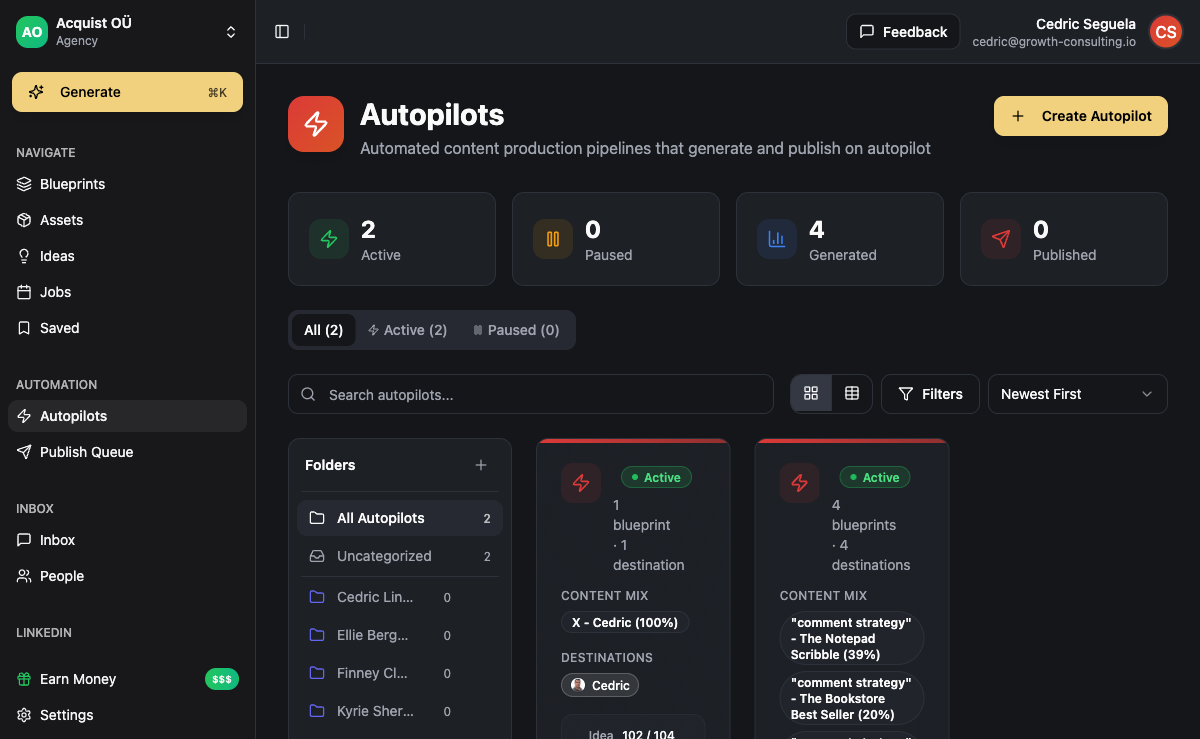
In Autopilots, create a new job. Select Twitter/X as the publishing channel, assign your blueprints, set the posting schedule (frequency and time-of-day windows), and activate. ACA runs the generation on schedule, formats the output correctly per blueprint, and publishes through Unipile. Different blueprints can run on different schedules - single tweets daily, threads twice weekly, reply chains triggered 48 hours after each thread.
Generating Threads with AI Brand Voice
Threads are where AI content generation has the highest leverage in terms of time saved. A manually written 8-tweet thread takes 45-90 minutes. An AI-generated thread from a well-configured blueprint takes seconds of compute time. The setup investment is front-loaded into voice and blueprint configuration.
What makes AI threads feel like genuine content rather than produced slop:
Hook specificity: The first tweet determines whether the thread gets read. Vague hooks ("Here's what I learned about B2B outbound") get ignored. Specific hooks tied to a real outcome, a counter-intuitive number, or a named problem get shares. Your blueprint should specify the hook pattern explicitly so the AI does not default to the generic format.
Knowledge base grounding: Without a knowledge base, AI threads produce generic industry observations anyone could have written. With a knowledge base containing your actual use cases, client results, and hard-won observations, the thread references real specifics. That specificity is what earns follows rather than scrolls.
As Cedric's experience running an outbound agency shows, the difference between AI content that builds an audience and AI content that disappears comes down entirely to voice fidelity and knowledge base depth - not to model quality. The model is a commodity. The context is not.
Automate Twitter/X posting when: you need consistent output across 5+ posts per week, you are managing multiple client accounts or brands, or content writing is consuming more than 3 hours per week. Automation compounds - 12 months of consistent output builds an account that generates inbound. Manual posting at that volume rarely survives.
Write manually when: you are responding to a breaking news moment, engaging in a live conversation that happened today, or crafting a post from a client interaction that needs immediate context. Real-time moments cannot be automated. The autopilot handles your baseline volume; manual posts handle the moments worth writing for specifically.
Posting Cadence: What Actually Works
Twitter/X timing benchmarks from ACA campaigns: Single tweets posted during morning windows (7-9am local time) and early afternoon (12-2pm) consistently outperform evening posts for B2B accounts. Threads perform best Monday through Wednesday mornings. Reply chains generate the highest re-engagement when published 48-72 hours after the original thread. These patterns hold across most B2B verticals - run your first 30 days then adjust to your audience's actual activity data.
A workable starting cadence for a B2B brand account:
- Single tweets: 1 per weekday. One tweet per day, consistently, compounds over 90 days into a recognizable point of view. Posting 5 tweets a day dilutes each one and makes the account look like a content farm.
- Threads: 2 per week, Monday and Wednesday morning preferred. One thread per major content pillar per month at minimum to give each topic enough airtime.
- Reply chains: Triggered automatically 48-72 hours after each thread. Adds a follow-up observation to keep the thread in circulation after the initial impression wave.
The goal is not maximum frequency. The goal is showing up consistently enough that when someone visits your profile after seeing a single tweet, they find an active account with a clear point of view. That is what converts a viewer into a follower.
For teams running Twitter/X content alongside B2B outreach, the combination is straightforward: outbound sales automation generates direct pipeline while Twitter/X builds brand familiarity with the same ICP. A prospect who has seen your threads before receiving your cold email converts at a noticeably higher rate.
If you are running Twitter/X alongside LinkedIn for a client, LinkedIn outreach automation handles the connection and messaging layer while your Twitter presence builds the ambient signal. For agencies building a full AI content operation, see how AI automation agencies run Twitter/X and LinkedIn content in parallel from the same ACA workspace with separate brand voice profiles per client.
Frequently Asked Questions
What is the best tool to automate Twitter/X posts with AI?
It depends on what "automate" means to you. If you want to schedule manually written posts, Buffer or Hootsuite do that cheaply. If you want AI to write the posts and then publish them, you need a platform with a content generation layer - not just a scheduler. ACA combines AI generation (blueprints, brand voice, knowledge base) with scheduling and publishing via Unipile, covering Twitter/X alongside LinkedIn, Instagram, and other channels from one system without separate tool subscriptions per platform.
Can you automate Twitter/X threads, not just single tweets?
Yes. Thread automation requires a platform that supports multi-tweet publishing in sequence - most simple schedulers do not handle this correctly. In ACA, the Thread blueprint outputs an ordered array of tweets that publish as a connected thread. You define the hook format and body structure in the blueprint; the AI generates thread content to those specifications on your configured schedule.
Will automated Twitter posts hurt engagement?
Only if the content is generic. The algorithm treats a well-written automated post identically to a manually written one - Twitter/X does not detect AI-generated text if the content quality is good. What reduces engagement is low-quality content that gets ignored or generates reports. The fix is better brand voice configuration and a more specific knowledge base, not removing automation from the process.
How many Twitter/X posts per day is too many for a B2B brand?
For a B2B brand account, 1-2 posts per day is the effective range. More than that compresses the performance window each post has before the next one replaces it in follower feeds, and the account starts to look like a content publishing operation rather than a practitioner with genuine views. Agencies managing multiple client accounts set different cadences per client, all from the same ACA workspace with separate brand voice profiles keeping each account distinct.
Can you automate replies to other people's tweets?
Auto-replying to other accounts' tweets is against Twitter/X's platform terms and triggers spam detection quickly. ACA does not support this. What you can automate is reply chains on threads you own - scheduled follow-up tweets that add to conversations you started. This stays within platform terms, keeps your content circulating beyond the initial impression window, and carries no ban risk. The line is clear: replying to your own content versus mass-replying to others' content.
Does Twitter/X automation work for personal brand accounts, not just company accounts?
Yes, but the setup requires more investment in voice configuration. Personal brand accounts need voice profiles that capture the individual's actual patterns - characteristic vocabulary, sentence rhythm, the topics they care about in their specific context. Generic voice profiles produce content that does not sound like a person. Plan for more sample tweets as voice reference input (10-15 versus 3-5 for a brand account), and the output quality matches. ACA supports both brand and personal brand voice profiles in the same workspace.