A Facebook post scheduler in 2026 needs to handle three publishing surfaces that behave very differently: Pages (your business broadcast channel), Groups (your community conversation channel), and Reels (your short-video discovery channel). Most schedulers only handle one. ACA covers all three from a single calendar by pushing content through your GoHighLevel sub-account, which means you keep the GHL social planner you already pay for and add AI content production, multi-account rotation, and bulk scheduling on top.
Short answer: The cleanest way to schedule Facebook Pages, Groups, and Reels on one calendar is to use a content engine that generates the posts (text, image, video) and pushes them into GoHighLevel's social planner, which already has native Facebook publishing for all three surfaces. ACA does the generation and the push. GHL does the publishing. You get one calendar, one approval flow, and full coverage across Pages, Groups, and Reels.
Why Facebook still matters for B2B and agency work
Most operators under 35 wrote Facebook off in 2022. That was a mistake. Facebook is still the largest social network on the planet, and three audience pockets in particular have not migrated: small business owners, local services, and tight-knit professional Groups that did not survive the move to Slack or Discord. If you sell to home services, real estate, fitness, e-commerce founders, or any local business operator, Facebook is where they spend evening hours.
The format that drives engagement on Facebook in 2026 is not the polished branded carousel that performs on LinkedIn. It is the long-form personal post — 600 to 1,200 words, written in plain language, ending with an open question that invites comments. Facebook's algorithm rewards dwell time and comment threads more than any other platform. A long post that gets read and replied to lands in feeds for days, not hours.
The three Facebook surfaces and why they need different treatment
Calling all of this "Facebook content" hides a real problem. Pages, Groups, and Reels are three different products inside the same app, with three different audience behaviors and three different optimal formats.
| Surface | What it is | Format that works | Posting cadence |
|---|---|---|---|
| Pages | Your business broadcast channel. Followers opted in once and may rarely visit. | Long-form text posts, native video, link posts with strong hook | 3 to 5 times per week |
| Groups | Community discussion space. Members get notifications and check in regularly. | Conversational prompts, polls, member shoutouts, value posts | Daily during active hours |
| Reels | Short vertical video discovery feed. Reaches non-followers. | 9:16 video, 15 to 60 seconds, captioned, hooks in first 2 seconds | 3 to 7 times per week |
A scheduler that treats all three as "a Facebook post" will fail you on at least two of them. You need different content types feeding different surfaces on the same calendar, with the calendar knowing the difference.
The single-calendar problem most agencies hit
If you run a content or social media operation for clients, you have probably tried to solve this with some combination of: Buffer or Hootsuite for Pages, manual posting for Groups (because most schedulers do not have Group API access), a separate tool for Reels, and a Google Sheet to keep track of what is going where. By month three the sheet is wrong, the Group has not been posted in for two weeks, and Reels are sitting in Drive folders waiting for someone to upload them.
Single-calendar publishing means every piece of content destined for a client — regardless of which Facebook surface it lands on — appears on one timeline, with one approval flow, one set of brand rules, and one analytics view. The benefit is operational: you can see at a glance whether your client is being published consistently across Pages, Groups, and Reels, and you can spot gaps before the client does.
How ACA schedules Facebook content via GoHighLevel
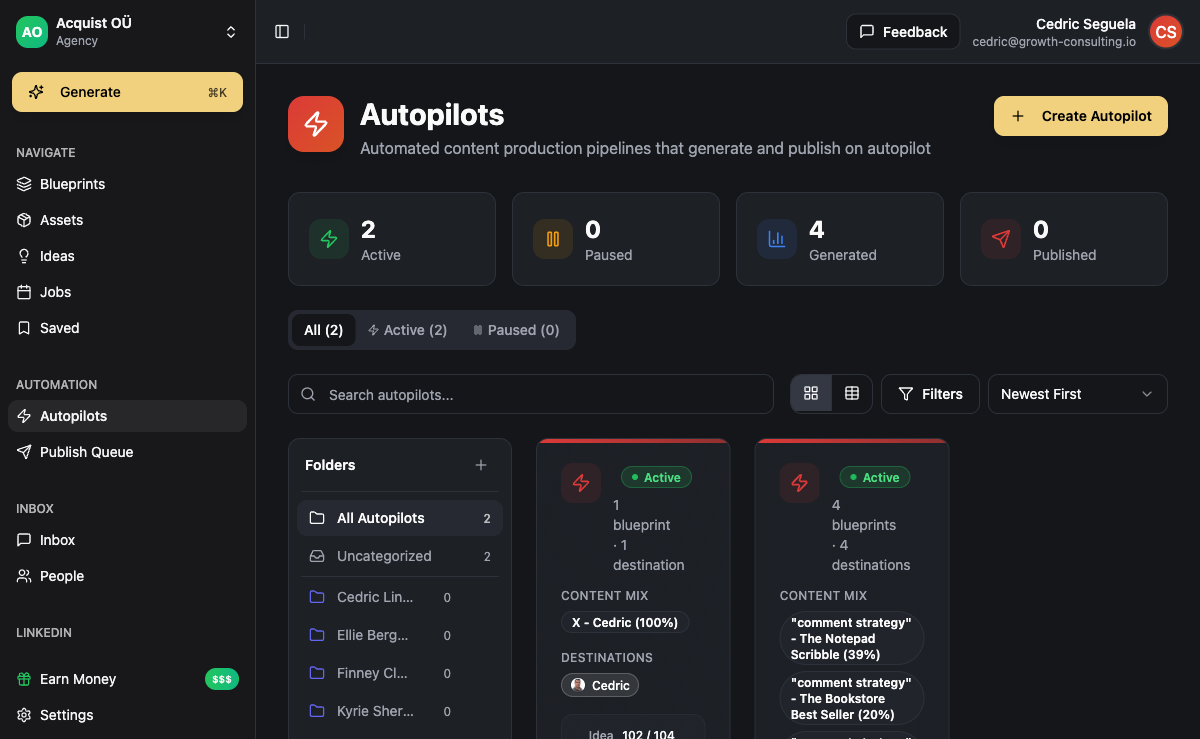
ACA does not publish to Facebook directly. It pushes content into GoHighLevel, which has Meta's official Pages and Groups API access and handles Reels uploads through the same social planner. The flow looks like this:
- You set up a content blueprint in ACA for the client — brand voice, content pillars, target audiences, posting cadence per surface.
- ACA generates the posts in batches: long-form Page posts, Group discussion prompts, Reels scripts with paired video generation.
- The content lands in GHL's social planner against the correct Facebook surface, on the correct date, ready for approval.
- You (or the client) approve in GHL using whatever review flow you already run.
- GHL publishes natively to Facebook on schedule. Analytics flow back into GHL's reporting.
The reason this matters: GoHighLevel is already the operating system for thousands of agencies. If you run client work through GHL, you do not need a second social tool. You need a content engine that respects where the work actually happens. ACA generates, GHL schedules. Your client logs into one place.
Use ACA + GHL when: you run client work through GoHighLevel, you need AI content production at scale, and you want Pages, Groups, and Reels all on one calendar without learning a new social planner.
Use a standalone Facebook scheduler when: you are publishing for your own single brand, you have a content team writing every post by hand, and GHL is not part of your stack.
The long-form Facebook post play most agencies miss
Here is the thing nobody scheduling Facebook content seems to understand in 2026: the algorithm still rewards long, personal, comment-driving posts more than any other format on the platform. While everyone chases Reels reach, the operators quietly winning on Facebook are running 800-word story posts on Pages and discussion threads in Groups, and getting hundreds of comments per post from genuinely engaged people.
The structure that works on Facebook long-form:
- Hook line one (1 sentence): a specific, slightly contrarian claim or a personal admission. "I fired three clients last month and our revenue went up."
- Story (300 to 700 words): the situation, what you did, what happened, what you learned. Plain language. Short paragraphs. No corporate hedging.
- Lesson (1 paragraph): the takeaway, framed as something the reader can apply.
- Open question (1 line): a question that invites a comment from someone who half-agrees or has a different experience.
ACA's content blueprints can generate posts in this structure directly, sized for the surface — long form for Pages, medium for Groups, with a Reels script optionally generated from the same story angle so the same idea ships across all three surfaces in the same week.
In our experience running content for agency clients: long-form Facebook Page posts (700+ words) outperform short Page posts on engagement rate by a wide margin, often 3 to 5 times more reactions and 5 to 10 times more comments. The same content cut down to a 30-second Reel reaches more people but converts less to comments. Both surfaces matter. They do different jobs.
Setting up your Facebook publishing pipeline
If you are starting fresh, here is the order of operations to get a working Pages + Groups + Reels calendar running for a client.
Connect the Facebook assets in GHL
In the client's GoHighLevel sub-account, connect the Facebook Page and any Groups they admin. Verify Meta Business Suite permissions are set correctly — this is where most setups fail. You need full Page management plus Group publishing permissions, granted by a Facebook admin of the Page.
Define content pillars per surface
Pages handle brand and authority content. Groups handle community and discussion. Reels handle discovery and reach. The same client's content strategy should look meaningfully different across the three. Decide upfront what each surface is for, or you will end up posting the same thing three times.
Set posting cadence and approval window
Decide how far ahead content is generated, how long the client has to approve, and what happens to posts that miss the approval window. A common rhythm: ACA generates one week of content every Friday, client has the weekend to approve, posts ship Monday through Friday the following week.
Configure brand voice and guardrails
This is the part most teams skip and pay for later. Spend an hour building the brand voice in ACA. Sample posts the client has loved. Phrases they would never say. Topics that are off-limits. The generated output is only as good as this configuration.
Common mistakes when scheduling Facebook content at scale
Treating Groups like Pages. Groups are conversations, not announcements. A Page post copy-pasted into a Group will get ignored or, worse, flagged by admins (if you are posting in someone else's Group). Generate Group content as discussion prompts, polls, or member-tagging shoutouts.
Posting Reels with horizontal video. Reels are 9:16. If your video is 16:9 with letterboxing baked in, the platform will deprioritize it. Generate vertical first or do not generate the Reel at all.
Ignoring the comment thread. Scheduling the post is half the work. The other half is replying to comments in the first hour, because that is when the algorithm decides how far the post travels. Build a notification flow so someone (the client, or you) sees comments within 30 minutes during business hours.
Generic AI content with no voice configuration. Facebook readers can smell generic AI from the first line. The hook either sounds like a real person or it gets scrolled past. Spend the configuration time upfront.
Running one Page for everything. If your client serves multiple audiences (e.g., a real estate brand that does buyer content and investor content), they need separate Pages or at minimum surface-specific Groups. One Page trying to talk to everyone reaches no one.
Who this setup fits, and who should look elsewhere
This Facebook scheduling approach works well for:
- Agencies running client social on GoHighLevel who want to add AI content production without leaving the GHL stack.
- Local services and home services businesses where Facebook is still the primary audience platform and long-form community posts drive leads.
- Coaches and consultants running a Facebook Group as their primary community asset, who need consistent daily Group content alongside Page broadcasts.
- E-commerce brands running shopping-tagged Reels who also need brand-building Page content.
It fits less well if Facebook is a minor channel for you, you do not use GoHighLevel, and you are not interested in long-form content. In that case, a single-platform scheduler with native Facebook publishing will do the job at lower cost and lower complexity.
Frequently asked questions
Can ACA schedule directly to Facebook without GoHighLevel?
ACA's Facebook publishing path goes through GoHighLevel today. If you do not have a GHL sub-account, you can still use ACA to generate the content and export it manually into Meta Business Suite or any other Facebook scheduler. Most agency users have GHL already, which is why the integration is built that way.
Does ACA schedule to Facebook Groups, not just Pages?
Yes, through GHL's Group publishing capability. You need to be an admin of the Group and grant Group publishing permission to the connected Facebook account. Personal Groups you do not admin cannot be scheduled to — that is a Meta API restriction, not an ACA limitation.
How long should a Facebook Page post be in 2026?
For engagement-driving posts, 600 to 1,200 words performs best in our experience. For announcements or link posts, much shorter (40 to 80 words plus the link). Reels captions stay under 150 words. The format depends on the goal of the specific post, not a one-size-fits-all rule.
Can the same content idea go to Pages, Groups, and Reels in the same week?
Yes, and it should. One core story or insight, formatted three ways: a long-form post on the Page, a discussion prompt in the Group asking members for their take, a 30-second Reel that delivers the hook. ACA generates all three from the same content brief, so you are not writing the same idea three times.
What about Facebook Stories and live video?
Stories are short-lived and tend to work better when posted in the moment rather than scheduled. Live video is by definition not schedulable, though you can schedule a Page post announcing the live. The Pages, Groups, and Reels trio covers about 90% of useful scheduled Facebook activity. Stories and Lives are best handled by the client or community manager in real time.
How does this compare to using Meta Business Suite directly?
Meta Business Suite is free and publishes natively, but it does not generate content, does not handle multi-client workspaces, and does not give you AI-assisted brand voice or content blueprints. If you have one client and a content writer producing every post, Business Suite is fine. If you have ten clients and need leverage, you need a content engine on top of it.