
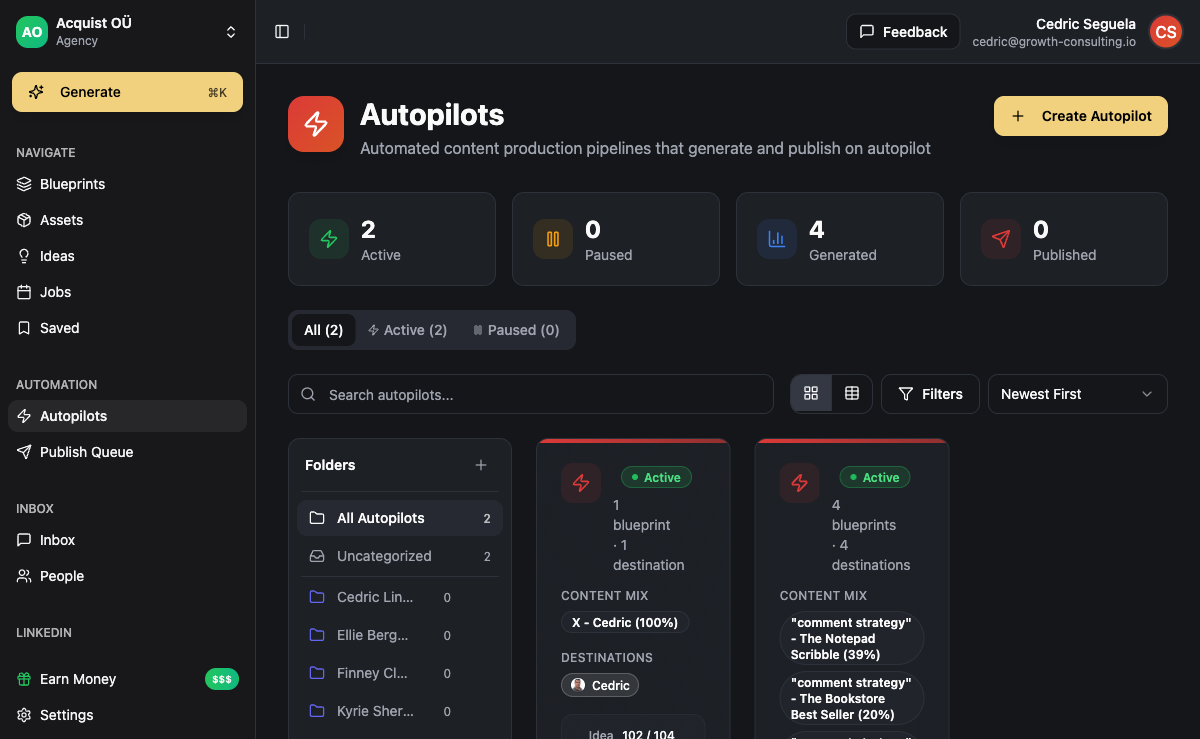
Social media automation in 2026 is not about filling a content calendar. Scheduling tools have existed for a decade and every marketing team already has one. What they do not have is the content - because someone still has to write the posts, design the graphics, and decide what goes where. The shift that changes the economics is AI that generates the content before scheduling it. ACA Autopilots run that full loop: brand-voice-aware content generation, automatic publishing across LinkedIn, X, Instagram, Facebook, and TikTok, and a pipeline that runs 24/7 without manual input once configured.
Short answer: Social media automation in 2026 means a system that generates platform-native content in your brand voice, schedules it at optimal times, publishes across multiple channels simultaneously, and tracks performance - all without manual input per post. A scheduling tool like Buffer or Hootsuite is a calendar. ACA Autopilots are a content engine. The difference is whether you are still writing everything yourself.
What Is Social Media Automation?
Social media automation is the use of software to handle the repetitive work in a social media presence: content creation, scheduling, publishing, comment routing, and performance tracking. In 2026, the definition has expanded to include AI-generated content - not AI-assisted suggestions, but fully generated posts, images, videos, and audio that match a specific brand voice and publish without human review of each individual piece. The defining line is no longer whether software handles the calendar. It is whether software handles the content before the calendar.
The practical range of social media automation runs from scheduling tools at one end to fully autonomous content pipelines at the other. Most businesses operate somewhere in the middle: they have a scheduling tool, they still write everything manually, and they post inconsistently because the content creation bottleneck never goes away.
What changed in 2024 and 2025 is the quality of AI-generated content. Not the generic output you get from typing "write a LinkedIn post about productivity" into ChatGPT. The output from a system trained on your specific brand voice, grounded in your ICP profiles, and drawing from your knowledge base. That output is now indistinguishable from content written by a skilled human. That is the threshold that makes full automation viable - and it is why the tools that only offer scheduling are being left behind.
The Scheduler Trap: Why Most Tools Miss the Point
Buffer, Hootsuite, Later, Sprout Social - these are scheduling calendars. They are excellent at what they do: organize posts, set publish times, manage multiple accounts from one dashboard. What they do not do is generate the posts. That is still your job.
The trap is this: you buy a scheduling tool, you feel like you have solved social media, and then you still do not post consistently because content creation is the hard part. The calendar is empty because you have not filled it. The tool did not solve the actual problem.
This is why the category is shifting. The scheduling layer is commodity. Every tool does it. The differentiation is moving to the content layer - who generates what, in what format, for which platform, in whose voice.
| Capability | Scheduling tools (Buffer, Hootsuite, Later) | ACA Autopilots |
|---|---|---|
| Schedule and publish posts | Yes | Yes |
| Multi-platform support | Yes | Yes |
| Generate post copy in brand voice | No (manual) | Yes |
| Generate images per post | No | Yes |
| Generate short-form video | No | Yes (Remotion pipeline) |
| Brand voice training on real samples | No | Yes |
| ICP-aware content targeting | No | Yes |
| White-label for agencies | Limited or no | Yes (per-client workspace isolation) |
| Outreach integration | No | Yes (LinkedIn + email + WhatsApp) |
If you are evaluating what comes after your current scheduling tool, the relevant question is not "which scheduler has a better UI." It is "which platform generates content so I stop writing it manually." For a direct comparison with tools in this space: Buffer alternatives that generate content instead of just scheduling it.
AI Content Generation: The Missing Layer
The scheduling layer is solved. The generation layer is what most businesses are still missing. Here is what AI-generated social content actually requires to work - not just be technically functional, but produce output good enough to publish without editing every line.
Brand voice training
A brand voice is not a persona description. "Professional but approachable" is not a brand voice. A brand voice is a set of real writing samples that show how the brand actually sounds: sentence structure, vocabulary range, what it avoids, what it leans into. ACA trains a brand voice from your actual content - past posts, email copy, founder writing - and uses that model to generate new content that sounds like the same person wrote it. The output sounds like you because it was trained on you, not on a generic archetype scraped from LinkedIn.
Content blueprints
A blueprint defines a content type: the format, the structural pattern, the call to action, the character speaking, the ICP it targets. You build blueprints once per content format - a "founder insight" LinkedIn post, an "educational thread" for X, a "product spotlight" for Instagram - and the Autopilot runs them on a schedule. One blueprint, hundreds of outputs over months. The system compounds: more blueprint runs mean more performance data, which means better blueprint calibration over time.
Multi-format output from a single brief
Text is table stakes. ACA Autopilots generate text, images, short-form video via the Remotion pipeline, and audio (TTS) - all from a single brief. One brief goes in, and the system generates platform-native variants for each channel automatically. A founder insight post becomes a LinkedIn text post, an X thread opener, and an Instagram carousel caption without separate prompting for each format.
Content volume benchmark: In our experience managing social media production for agency clients, a single configured Autopilot pipeline generates 20-40 pieces of platform-native content per week per client with no manual intervention after setup. Setup time is 4-6 hours per client. After that, the system runs on schedule indefinitely - including image generation and publishing.
Multi-Platform Publishing: LinkedIn, X, Instagram, Facebook, TikTok
Every major platform has different content requirements. LinkedIn performs best with longer-form posts, professional framing, and engagement hooks in the first two lines. X rewards brevity, strong opinions, and thread structures. Instagram is visual-first with short captions. Facebook works for community-style posts and video. TikTok demands short-form video with a hook in the first second.
Publishing the same content to every platform does not work. The same text that performs on LinkedIn will underperform on X and get no traction on Instagram. Platform-native content requires adapting structure, length, hashtag use, and format per channel.
ACA Autopilots handle this by generating platform-specific variants from a single source brief. A blueprint that produces a "founder insight" post generates the LinkedIn version (400-600 word post with hook, story, and CTA), the X version (punchy take or thread opener), and the Instagram version (visual + short caption) from the same input. The AI adapts structure and tone per platform while keeping the brand voice consistent across all of them.
Platform-specific guides:
- LinkedIn: running social media on autopilot - full setup walkthrough with LinkedIn as the lead channel
- Twitter/X: how to automate Twitter/X posts and generate threads at scale
For LinkedIn specifically, the content layer connects directly to the outreach layer. A strong LinkedIn content presence warms your target audience before you send connection requests - meaning better acceptance rates and warmer reply rates from sequences. The two are not separate systems; they reinforce each other. Full guide on combining both: LinkedIn automation guide covering content and outreach together.
Brand Voice Configuration That Makes AI Sound Like You
The most common reason AI-generated social content fails is not the model. It is the configuration. Generic AI writers produce output that sounds like everyone else's AI content, because they are trained on the same general internet text. The voice is interchangeable. You can tell it is AI because it sounds like AI - not because it is technically wrong, but because it has no specific personality.
What separates content that reads like a human wrote it from content that reads like AI output is the same thing that separates a good copywriter from a mediocre one: deep understanding of the specific person's voice at a granular level.
ACA's brand voice system works like this:
- Training samples: Upload 20-50 pieces of writing from the brand or founder - LinkedIn posts, email copy, sales scripts. The more samples, the more accurate the voice model.
- Voice parameters: Define explicit rules - formality level, sentence length preferences, vocabulary inclusions and exclusions, what the brand never says.
- Character layer: Assign a character to speak the content. For most brands, this is the founder. For agencies managing multiple clients, each client has their own character profile that speaks in their voice independently of every other client in the system.
- ICP grounding: Tell the system which ICP segment the content targets. Content written for a B2B SaaS founder sounds different from content written for a small business owner, even in the same brand voice. The ICP context shapes framing, examples, and pain point references.
- Knowledge base: Inject your specific expertise, case studies, and proof points into the generation context. The AI references your actual data and experiences, not invented examples.
The result is content that reads like it came from the person, not from a tool. That distinction matters for engagement rates, personal brand consistency, and the credibility signals that AI search engines are using to evaluate content quality in 2026. For how this feeds into a content production system at scale: scaling AI content production across channels without losing brand consistency.
You're paying $2,000 per month for a VA who writes social posts that go out three times a week. ACA generates 30 posts per week across five platforms, in your voice, for a fraction of that cost.
ACA Autopilots: Step-by-Step Setup
Here is the complete setup sequence for a working ACA Autopilot. This assumes you have connected your social accounts and configured at least one brand voice.
Step 1: Connect your publishing accounts. ACA connects to LinkedIn, X, Instagram, Facebook, and TikTok via the GHL publishing integration. You authorize each account once. The Autopilot then has permission to publish on your behalf on the schedule you define. Multi-account setups (useful for agencies managing client accounts) are supported from the same workspace.
Step 2: Create a brand voice. Upload writing samples, set voice parameters, assign the character. For agency use, create a separate brand voice per client - each trains independently on that client's actual writing. Voice training takes 15-30 minutes per brand and runs in the background while you continue setup.
Step 3: Build content blueprints. A blueprint defines a content type: the format, structural prompt, target ICP, which brand voice to use, which platforms to publish to, and the output format (text, text plus image, video). Start with two or three blueprints covering your main content categories. You can always add more as you see what resonates.
Step 4: Configure the Autopilot schedule. Set which blueprints run on which days, at which times, to which platforms. A typical B2B setup: LinkedIn posts Monday and Wednesday at 9 AM, X threads Tuesday and Thursday at 11 AM, Instagram posts Friday at 10 AM. The Autopilot generates each piece the night before, queues it, and publishes at the configured time. No manual intervention.
Step 5: Review the first batch manually. For the first week, review generated content before it goes live. Not because the quality will be bad - but because it will show you quickly whether the brand voice training captured the right tone. Make adjustments to training samples or voice parameters if anything reads off. After the first week, most setups run without review.
Step 6: Monitor performance and iterate blueprints. Check engagement data weekly. Posts that outperform - high saves, comments, shares - inform updates to your blueprints. Posts that underperform flag voice or ICP calibration issues. The system gets better the longer it runs because you refine it based on real data from real audiences.
White-Label Social Media Automation for Agencies
If you manage social media for clients, the economics of AI-generated content change significantly. The per-client cost of content production drops to near zero after setup. The margin on social media management services goes up. And the white-label architecture means clients see your brand, not the underlying technology.
ACA's multi-tenant architecture gives each client a fully isolated workspace:
- Separate brand voices per client: Client A's voice never bleeds into Client B's content. Each voice trains independently on each client's actual writing.
- Separate publishing accounts: Each client's social accounts connect within their own workspace. No accidental cross-posting, no shared data between clients.
- Separate content calendars: You manage all clients from your central agency view, but each client has their own calendar and blueprint configuration. You can see everyone at once or drill into a single client view.
- White-label interface: Clients log in to a branded interface under your agency's domain and logo. ACA is the infrastructure. Your agency is the product.
The pricing model typically works like this: you charge each client $1,000-$2,500 per month for done-for-you social media management. Your actual delivery cost using ACA is a fraction of that. The gap is your margin, and it widens as you add clients without proportionally increasing your time investment per client.
Social media automation is often the easiest entry point for new agency clients. The deliverable is visible (posts appearing in their feed consistently), the value is intuitive (more content, more often), and it opens upsell paths to outreach, lead generation, and CRM management. For the full AI agency model: how to build an AI automation agency that runs on one platform. And for signing your first clients: how to start an AI agency from zero.
Use a scheduling tool (Buffer, Later, Hootsuite) when: you manage one personal brand with minimal posting frequency, you always have pre-written content ready to queue, and you do not need to scale beyond 3-5 posts per week manually.
Use ACA Autopilots when: content creation is the bottleneck, you manage multiple brands or clients, you want volume above 10 posts per week across multiple platforms, you need AI-generated images and video alongside text, or you want to white-label the service for paying clients.
Measuring What Actually Matters
Social media metrics are often tracked at the wrong level. Vanity metrics - follower counts, impressions, reach - tell you very little about whether your social media presence is driving business outcomes. A million impressions from the wrong audience converts at zero.
The metrics that matter for B2B social media automation:
- Engagement rate per post (not total impressions): A post with 5,000 impressions and 200 engagements is better than a post with 50,000 impressions and 100 engagements. The ratio tells you whether the content resonates with the audience that sees it - which is the signal worth optimizing.
- Profile views and connection requests: On LinkedIn, content that drives profile views and connection requests is generating pipeline. Measurable and directly tied to content performance.
- Inbound DMs and replies: Inbound messages from content watchers are the highest-quality signal that your content is working as an acquisition channel. Track these separately from passive engagement metrics.
- New followers from specific posts: A spike in followers after a specific post tells you which content format, topic, or voice struck a chord. Use that data to update your blueprints toward more of what works.
- Saves and bookmarks: Saves indicate high-value reference content - the kind that compounds over time as people return to it. A high save rate on educational content means it is genuinely useful, not just scroll-stopping.
ACA tracks content performance within the platform and maps it back to blueprint configuration. Blueprints that consistently produce high-engagement content generate more attribution data. Blueprints that underperform flag for review. This closes the feedback loop between content strategy and execution - something manual content management cannot do at scale.
FAQ
What is the difference between social media automation and social media scheduling?
Scheduling is one feature inside automation. A scheduling tool lets you queue pre-written posts to publish at set times. Social media automation includes everything that happens before scheduling: content generation, image creation, video production, ICP targeting, and brand voice configuration. Scheduling is the delivery mechanism. Automation includes generating what gets delivered.
Is social media automation safe for your accounts?
Platform-level automation varies in risk by platform. LinkedIn has rules against scraping and certain third-party automation, but scheduling and content publishing through official API integrations is permitted and safe. Instagram, Facebook, TikTok, and X all have official publishing APIs that platform-native tools use within the platforms' terms of service. ACA publishes through the GHL integration, which uses official channel APIs - not browser extensions or session manipulation that trigger platform safety systems.
How many posts per week should you automate?
Optimal posting frequency varies by platform. LinkedIn: 3-5 posts per week for most B2B accounts. X: 3-7 posts or threads per week. Instagram: 4-7 posts plus stories. Facebook: 3-5 per week. TikTok: daily or near-daily for growth, 3-5 for maintenance. With ACA Autopilots generating all content automatically, hitting these frequencies is a configuration decision rather than a time investment. The constraint is content quality and blueprint calibration, not available hours.
Can you automate comments and replies too?
Automated comments on other people's posts carry risk - platforms flag them as spam and accounts can be penalized. What is safer and more effective: ACA Autopilots handle top-of-funnel content generation and publishing. The engagement layer - replies to comments on your posts, DM follow-ups from people who engage - routes through ACA's unified inbox. You or your team handles replies there, with AI-assisted response suggestions. The content pipeline is fully automated; the conversations that arise from it are handled through a single inbox view across all channels.
How does AI-generated content perform compared to manually written posts?
In our experience running brand voice-trained Autopilots, the performance gap between AI-generated and human-written content narrows significantly when the brand voice is properly configured. The biggest factor is not AI vs. human - it is whether the content is specific and opinionated vs. generic. AI content trained on real brand writing and grounded in specific ICP knowledge performs comparably to skilled human-written content. Generic AI content (no voice training, no ICP grounding) underperforms consistently. The system matters more than the question of who wrote it.
How does ACA compare to Taplio for LinkedIn content automation?
Taplio is a LinkedIn-specific content tool with scheduling, inspiration features, and an AI writing assistant. For LinkedIn personal brand management with a basic AI layer, it works. The limits: LinkedIn only, no outreach integration, no multi-channel sequences, no CRM, no white-label architecture for agencies. ACA handles LinkedIn content generation and scheduling as one component of a system that also includes outreach sequences, multi-channel messaging (email, WhatsApp, Instagram), unified inbox, and full agency white-label. For a detailed comparison: ACA vs Taplio - what each does and what you actually need.